HOW DO I IMPROVE MY
PRACTICE AS AN INCLUSION
OFFICER WORKING IN A
CHILDREN'S SERVICE
Christine Jones
MA Professional Learning
(Professional Practice)
This dissertation is submitted in part
fulfilment of the regulations for the MA in
Professional Learning
Bath Spa University
2009 - (Graduating 17 July 2009)
SIGNED STATEMENT
This dissertation is an
original piece of work. It is my own work and has not been submitted either in
the same or different form to this or any other Higher Education Institution
for a degree or other award. It is available for photocopying and for
inter-library loan, with the permission of the Head of the School of Education.
Signed: Date:
ACKNOWLEDGEMENTS
I
would like to thank a number of people who have worked with me and supported
and influenced me throughout the development of my inquiry.
The
teachers with whom I have worked in a variety of workshops.
The
Special Educational Needs Coordinators (SENCOs) with whom I have worked on the
SENCO courses during the last four years.
The
schools which have worked towards the Bath and North East Somerset Inclusion
Quality Mark.
The
mentors and assessors involved in the Bath and North East Somerset Inclusion
Quality Mark.
Jack
Whitehead, who has been a constant support and inspiration.
My
friend and colleague, Marie Huxtable, for her support and time.
Nigel
Harrisson and Sandra Harris for their contributions.
My
colleagues at Conversation Cafe who have been my critical friends.
All
those who have given their permission for video clips, still images and
quotations to be used.
My
supervisor, Mim Hutchings, for her advice and support
My
husband, Brendan, for his constant support.
My
mother and two sons, Adam and Michael, for their constant interest.
ABSTRACT
This dissertation examines my embodied knowledge and development as an Inclusion Officer working in a Children's Service as I focus on making a contribution to educational knowledge. In making this contribution, I have used visual narratives. This dissertation focuses on my personal knowledge and experience as an Inclusion Officer as I inquire into my question, 'How do I improve my practice as an Inclusion Officer?' In making my personal knowledge public, I believe that I am contributing to educational knowledge by using a living theory methodology for exploring the implications of questions such as, 'How do I improve my practice?' and by clarifying the meanings of inclusional standards of judgement from a perspective of inclusionality. Inclusionality (Rayner, 2004) may be described as a relationally dynamic and responsive awareness of others which flows with a desire to live values of care, compassion, love, justice and democracy. I explicate the inclusional way in which I like to work with others, how my practice is based on the values I hold and how this is reflected in my relationship with other educators working in a Children's Service and schools.
In undertaking my inquiry,
I have adopted a living theory methodology (Whitehead, 2008a) in the sense that
I am bringing my embodied knowledge into the public domain as an explanation of
my educational influences in my own learning, in the learning of others and in
the learning of social formations. Using video, I clarify the meanings of my
inclusional values and how they are formed into living standards of judgement,
whereby I and others can judge the validity of my claim to knowledge.
CONTENTS
CONTENTS OF CD ROM – VIDEO CLIPS
Impact of Incidents in My Childhood
Impact of Early Experiences in my Teaching
Career
CHAPTER 2
– INCLUSION, INCLUSIONALITY AND MY ROLE AS AN INCLUSION OFFICER
My Role as an Inclusion Officer
The Bath and North East Somerset Inclusion
Quality Mark
CHAPTER
3 - METHODOLOGY AND METHODS..
Narrative Inquiry and Action Reflection Cycles
Validation Group and Critical Friends
CHAPTER 4
- NARRATIVES OF LIVING MY PRACTICE
AS AN INCLUSION OFFICER
Development of a Course for New Special
Educational Needs Coordinators (SENCOs). A Summary
Creativity Workshop, SENCO Forum, Bath and North East Somerset, June
2006. A Summary
The Pilot of the Bath and North East Somerset
Inclusion Quality Mark.
The Role of Mentors and Assessors in the Bath
and North East Somerset Inclusion Quality Mark
The Bath and North East Somerset Inclusion
Quality Mark Recognition Ceremony
CHAPTER 5 - MY EDUCATIONAL NARRATIVE OF MY LEARNING
Reflection on My Narratives as an Inclusion
Officer
Reflection on the Development of My
Dissertation
Reflection on the Use of Video
Reflection on Conversation Cafe
Appendix A - Summary of Work of Inclusion Officer,
July, 2004
Appendix B - Research Brief and Consent Form
Appendix F - Transcript of Validation Meeting, 17
July, 2008
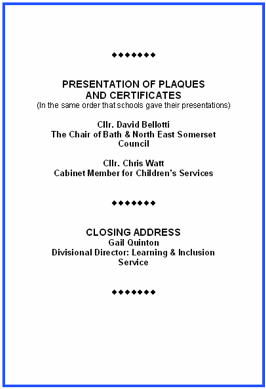
Appendix G (i) - Programme of IQM Recognition Ceremony- front and
back pages
Appendix G (ii) - Programme of IQM Recognition
Ceremony – middle pages
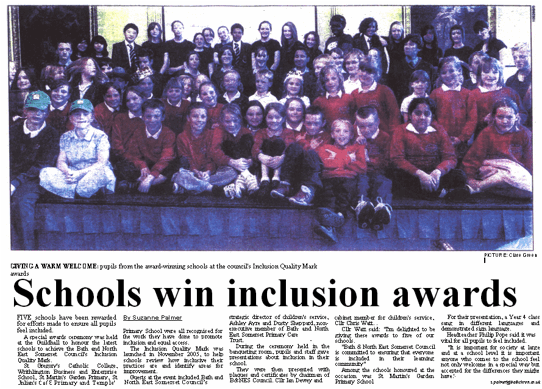
Appendix H - Newspaper Article and Photograph of IQM
Recognition Ceremony, 2007
Appendix J - Account by Sandra Harris
Appendix K - Account by Nigel Harrisson
LIST OF PLATES
Plate 1: Chris speaking to colleagues................3
Plate 2: Alan Rayner......................24
Plate 3: Chris at the BERA Conference, 2006............64
Plate 4: Antony at the Bath and North East Somerset Inclusion Quality Mark
Presentation, 2008..........................................................67
Plate 5: School at Recognition Ceremony, 2008............74
Plate 6: School at Recognition Ceremony, 2008.............75
Plate 7: Chris at Recognition Ceremony, 2008..............77
Plate 8: Chris speaking to colleagues....................Appendix C 109
Plate 9: Marie and Chris, Creativity Workshop, 2006 Appendix D 119
Plate 10: Chris and Marie, Creativity Workshop, 2006 Appendix D 120
Plate 11: Chris and Marie, Creativity Workshop, 2006 ...Appendix D 121
Plate 12: Winnie the Pooh............................Appendix E 125
Plate 13: Participant at Emotional Literacy Workshop, 2006....Appendix E 126
Plate 14: Jet at Emotional Literacy Conference, 2006....Appendix E 127
Plate 15: Chris at Emotional Literacy Conference, 2006....Appendix E 128
CONTENTS OF CD ROM – VIDEO CLIPS
(The video clips can
be found on the CD ROM included with the dissertation. The video clips can also
be accessed by clicking on the links under each of the plates in the text.
Video clip 1 CD
1. Chrisschool.mov ..........3
Chris
speaking to colleagues about a childhood memory
Video clip 2 CD
2. Rayner.mov ..........24
Alan Rayner demonstrating
his Paper Dance of inclusionality
Video clip 3 CD
3. Chrisbera06.mov (move cursor to 2.04mins
and stop at 3.35 mins) ..........64
Chris
explaining to delegates at the BERA Conference 2006 about the quality of
relationships mentors and assessors look for when going into a school
Video clip 4 CD
4. IQMAntonymentor2008.mov ..........67
Antony
describing the role of mentor
Video clip 5 CD
5. PschoolIQM08.mov ..........74
School at Recognition
Ceremony 2008 singing, 'We Can Live as One'.
Video clip 6 CD
6. Smtschool08.mov ..........75
School at Recognition
Ceremony 2008 singing, 'You've Got a Friend'.
Video clip 7 CD
7. Chrisrec040707.mov ..........77
Chris giving her
presentation at the Recognition Ceremony, 2007
Video clip 8 CD
8. Chrissenco.mov Appendix
C 109
Chris speaking to
colleagues about the connection she feels with SENCOs
Video clip 9 CD
9. ChrisandMarie1.mov Appendix
D 119
Chris and Marie with
participants at the Creativity Workshop, 2006
Video clip 10 CD
10. ChrisandMarieegg.mov Appendix
D 119
Chris and Marie
participating in 'egg activity' at the Creativity Workshop, 2006
Video clip 11 CD
11. ChrisandMarie3.mov Appendix
D 120
Chris and Marie after the
'egg activity' at the Creativity Workshop, 2006
Video clip 12 CD
12. ELworkshopwarmingup.mov Appendix E 125
Participants responding to
jokes at Emotional Literacy Workshop, 2006
Video clip 13 CD
13. C.mov Appendix
E 126
Participant describing an
emotionally literate moment in her classroom at the Emotional Literacy
Workshop, 2006
Video clip 14 CD
14. Jet.mov Appendix
E 127
Jet describing an
emotionally literate moment in her classroom at the Emotional Literacy
Workshop, 2006
Video clip 15 CD
15. ChrisendEL.mov Appendix
E 128
Chris explaining to
participants that what they have described are their living standards of
judgement of emotional literacy at the Emotional Literacy Workshop, 2006
INTRODUCTION
This dissertation will focus on the kind of research that can bring into the public domain my personal knowledge and personal experience as an Inclusion Officer employed by a Local Authority. My main research question is, 'How do I improve my practice as an Inclusion Officer working in a Children's Service?' In addressing this question, I intend to make a contribution to educational knowledge. I intend to do this by clarifying the nature of the values and energy that form the explanatory principles in my living theory of my practice. Vasilyuk (1991) has pointed to the weakness of social science explanations of human actions that do not include flows of energy in explanatory principles.
Through the analysis of
video clips of my professional practice, I shall be clarifying my meanings of a
flow of life-affirming energy with the values I use to give meaning and purpose
to my life in education. I want to clarify that I am not using any existing
analytic framework in the analysis of the video clips. I am exercising what
Dadds and Hart (2001) refer to as methodological inventiveness. In their
description of methodological inventiveness, they point out that how
practitioners choose to research, and their control over this, could be equally
important to their motivation, their sense of identity within the research and
their research outcomes.
In using a living theory methodology (Whitehead, 2008a), I engage in a process of reflection that includes an analysis of experience that leads to new knowledge and understanding. By this, I mean that I clarify, through reflections on my experience of existing as a living contradiction, the meanings of the values I use to give meaning and purpose to my life as an Inclusion Officer. This involves an awareness of tensions and living contradictions as I explore the implications of my question, 'How do I improve my practice as an Inclusion Officer?' My living theory methodology includes analysing video records of my practice. The analysis focuses on the expression, clarification and communication of the meanings of my values as these emerge in the course of my exploration of my question. My values distinguish what I understand as an improvement in my practice. Using digital video data, I explicate meanings of life-affirming energy and the meanings of my embodied values that distinguish my practice as educational.
Because of the dominating
use of analytic frameworks in explanations of educational influence, I want to
stress the difference between my relationally dynamic analysis of what I do and
the application of a pre-existing framework to what I do. In the relationally
dynamic analysis, I am generating meanings as I respond to what I can be seen
to be doing on the video. In particular, I am generating, clarifying and
communicating the meanings of the energy-flowing values of inclusionality that
distinguish my practice as inclusional. Rayner (2004) has pointed to the
relationally dynamic awareness of space and boundaries that is needed to
produce inclusional explanations of educational influence.
I believe that there is
something original in the way in which I have used video to presence myself to
myself in terms of the values I express in giving meaning and purpose to my
life in education. The originality lies in acknowledging to myself, through the
video, the life-affirming energy and values I express in my inclusional
practices. It also lies in my use of video to communicate the meanings of these
flows of energy with values to others in the explanation of my educational
influence as I generate my living educational theory.
My rationale for this
research-based approach to improving my professional practice is the belief
that there is little public knowledge of what Inclusion Officers do in terms of
their educational influences in learning. The rationale for making public my
embodied knowledge is the one expressed by Catherine Snow:
The challenge is to enhance the value of
personal knowledge and personal experience for practice. Good teachers possess
a wealth of knowledge about teaching that cannot be currently drawn upon
effectively in the preparation of novice teachers or in debates about practice.
The challenge here is not to ignore or downplay this personal knowledge, but to
elevate it.
(Snow, 2001:9)
Snow further explains that
the reason that the knowledge of teachers is untapped is because there are no
procedures for systematizing it. She feels that this systematized knowledge
would certainly enhance research-based knowledge which is already being
introduced into teacher training programmes. Furlong and Oancea (2005)
highlight some of the issues about judging the quality of practice-based
research, but state that whilst improving practice, can also contribute to
theoretical knowledge.
I agree with those researchers who believe that it is important to distinguish education research from educational research. Whitty (2006) believes that 'education research' should characterise the whole field whilst 'educational research' should refer to the narrower field of work specifically geared to the improvement of policy and practice. I also agree with Whitehead (2008a) in that it is important to distinguish education theories generated by researchers in the philosophy, psychology, sociology, history, economics, leadership, administration, politics and theology of education from educational theories generated to explain the educational influences of individuals in their own learning, in the learning of others and in the learning of social formations. I am submitting my dissertation as a contribution to educational knowledge within this view of educational theory. In particular, I believe that I am making an original contribution to a living theory methodology in explicating meanings of energy-flowing standards of inclusionality through the use of visual narrative.
Besides developing courses and running workshops, one of my main responsibilities has been to implement and develop an Inclusion Quality Mark for schools in the authority in which I work. I am responsible for the assessment of schools in the achievement of this award. I do not want the achievement of the Bath and North East Somerset Inclusion Quality Mark to be the result of 'ticking the right boxes' (Kennedy, 2005). When I walk into a school, I want, not only to see inclusive practice in action, but to see and feel the quality of relationships in the school community: the head teacher, pupils, parents, teachers, teaching assistants, school meal supervisory assistants (SMSAs) governors and administrative staff working inclusionally, valuing each other for who they are and the contributions they make, and demonstrating the values of inclusionality to which I aspire in my practice.
In my dissertation, I describe
inclusion and inclusionality and emphasise the relationship between the two. I
describe my developing understandings of inclusion and how, when I was
introduced to inclusionality, the impact this had on me and how I saw it in
relation to inclusion. This has had a dramatic impact on my role as an
Inclusion Officer, especially in the awarding of the Bath and North East
Somerset Inclusion Quality Mark.
I have organised the narratives in chapters. In the first chapter I reflect on formative experiences that have influenced my values. In Chapter Two, I consider meanings of inclusion and inclusionality and describe my role as an Inclusion Officer. In Chapter Three, I focus on my methodology and methods. In Chapter Four, I engage in a self-study of my practice as an Inclusion Officer. In this self-study I briefly describe three narratives, the full accounts of which can be found in Appendices C, D and E. These include the development of a course for new SENCOs, a creativity workshop at a SENCO Forum which I led with a colleague and thirdly, an emotional literacy workshop at an Emotional Literacy Conference which again I led with a colleague. I then describe examples of inclusionality in a further three narratives through my work on the Bath and North East Somerset Inclusion Quality Mark. In Chapter Five, I write an educational narrative of my learning and in Chapter Six, I give a brief conclusion of my dissertation.
The purpose in presenting these narratives
which include video data is to clarify the meanings of the values I use to make
judgments about improvements as I explore the implications of asking,
researching and answering my question, 'How do I improve my practice as an Inclusion
Officer?' In using video, I am able to see and reflect on my practice, and as I
move the cursor in the video clips, I can see the energy with which I work and
my inclusional way in which I like to work with others. I am not using video
clips, merely, as examples of my practice. I am using the video clips to
analyse my practice as I watch them. The way I watch them is important. I
presence myself to myself as I move the cursor backwards and forwards along the
clip, until I experience a resonance within myself at the points where I see
myself living the values that I use to give meaning and purpose to my life. I
use these energy-flowing values as explanatory principles to explain why I do
what I do. In this way, I am able, not only to identify the educational influences
in my own learning, but to explain these influences in my own learning. My
purpose in presenting and analysing the narratives in this way is to bring a
new energy-flowing and relationally dynamic standard of judgment of inclusion
into the Academy.
CHAPTER 1 - BACKGROUND
In this
chapter, I describe the experiences in my life that have had a significant
impact on me and have had and impact on my role as an Inclusion Officer.
Firstly, I describe incidents in my childhood, whereby my values such as justice,
fairness, care and compassion became embedded. I then describe my early
experiences in my teaching career which were extremely significant in my
professional development with regard to my understanding of diversity, my
relationship with children and young people, and my developing understanding of
inclusion as I moved from the integration to the inclusion of children and young people with special educational needs in
schools. I write narratives of my experiences. Connelly and Clandidin state
that:
Humans are storytelling organisms
who, individually and collectively, lead storied lives.
(Connelly
and Clandidin, 1990)
So, my
'storied life' begins
Impact of Incidents in My Childhood
I was brought up in a
small industrial town in South Wales. From a young age, I was very aware of the
injustice and the damage that could be done when individuals wielded their
power over the other purely because they were able to do it. Very strong
memories stand out, all related to my experiences at school. This is ironical
because I enjoyed school and I was very happy at school. The examples I quote
are by no means unusual, and my peers witnessed and experienced the same as I
did in one way or another, but I do believe that I had a tremendous sensitivity
and awareness of the way that people treated the other and how people could be
subjected to humiliation, discomfort and pain purely from being human and being
who they were.
My first memory of being treated 'unfairly' was when I was in
what would now be called Reception Class. My teacher called me a naughty girl
in front of the class for inadvertently damaging the wall display behind me as
a result my swinging on a chair. I remember vividly how I felt at the time. I
was extremely upset as I had not realised what I had been doing and to be
publicly humiliated in this way was unnecessary and damaging. I remember
thinking at the time that one day I would become a teacher and 'do it the right
way'. I expressed these views to my colleagues.
Plate 1: Chris speaking to colleagues
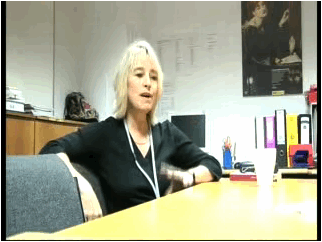
As I watch the video clip,
I see myself reflecting on that time in the classroom as I describe my
experience. As I am speaking, I can see the classroom and where I am sitting,
and I can see the teacher at the front of the classroom. I am feeling those
emotions that I felt at the time.
My next memory relates to
my experience in Year One when I was looking up at the ceiling and working out sums
in my head, which had been written on the board. I then felt this pain in my
back. The teacher had thumped me and asked me what I was doing. 'I am thinking,
Miss,' to which she replied, 'You're not here to think; you're here to work.' Immediately, I put my head down and
started to write blindly. I wanted
to cry, not because I was physically hurt but because I was so angry. I had not
done anything wrong. I had been working and her actions and comments were
unfair and unjust. Why didn't she ask me what I was doing before she thumped
me? It is so important to engage with learners and to trust learners. Hart shares her research and focuses on a teacher named
Julie:
Julie realises that she cannot just rely on
her own observations
to make accurate judgements about how
students are responding.
She encourages dialogue with them in order to
find out what is going
on in their heads.
(Hart, 2003:227)
This links very much with
my own ideas of the importance of having a dialogue with pupils. I express this
in my next section, 'Impact of Early Experiences in my Teaching Career ', when I realised how important it was to talk
with pupils and get to know them, and how this realization had an impact on my
relationship with pupils for the rest of my teaching career.
My third memory was in my
final year at Infant School. There was a girl in my class, who was ridiculed by
many of the pupils. I still remember her name but so that she remains
anonymous, I shall call her Mary.
I don't know the facts of her background but pupils laughed about her
clothes and made derogatory comments about her mother. How do people have the resilience to
bear this every day? She was often late and frequently absent. I felt sorry for
her as she was always the butt of jokes. Then one day, she came in late for
school and the teacher called her to the front of the class and started
mimicking her and humiliating her. The class was the audience. The teacher
would ask her a question about her being late and Mary would answer, and the
teacher would mimic her by repeating her answer word for word in a whiny voice.
Mary started crying but the teacher continued and she made Mary stand in front
of the class with tears streaming down her face as the abuse continued. 'Look
at Mary – enough tears to fill a reservoir!' I so desperately wanted the
teacher to stop and found being a witness to this almost unbearable. The
teacher should be protecting Mary. She was a vulnerable pupil and should never
have been the subject of such humiliation. Nobody should be the subject of such
humiliation.
As I
relate each of these stories, I am feeling the emotions that I felt at the time,
and I ask the question as I did then, 'Who has the right to treat another in
this way?' I am reminded of a moving story related by McNiff (2006) when McNiff
gives reasons as to why she continues to work in such places as South Africa
where she sees people using their position of privilege to the detriment of
others. She draws upon the work of Shula Marks(1989). She refers specifically
to Lily Moya, a black African woman and Mabel Palmer, an elderly, white
academic who provided many university opportunities for black students and
offers to support Lily in her education. Whilst being very supportive of Lily
initially, when Mabel feels that Lily is becoming too confident in the development
of their relationship, she completely undermines her and withdraws all hope.
This has a devastating effect on Lily who, twenty five years later, is found
living with her family looking thin and wasted after ending up in an
institution for the mentally ill. This is a story of the abuse of power with
devastating consequences.
I was aware of the
emotions I have expressed from a young age when I was being treated, in what I
felt, was an unfair way, or when I witnessed someone else being treated unfairly. It was from this
young age that I felt that nobody should judge another; nobody should assume
what another is thinking or feeling; nobody should use their 'power' to
belittle someone else; everyone is of value, and should be valued and treated
with respect.
Throughout Infant and
Junior Schools, I was picked on by one person in particular. I shall call her
Pam. My mother used to go to the school to discuss this with the head teacher
but it still continued. Pam always 'won' and I would end up on the floor but it
was not without a battle. Pam was bigger and older than I was. I was never
frightened of Pam; rather, I found
the constant battles tedious. Each time I remember being fired up and
gave my best and although physically over-powered, I never felt defeated. I
never would be defeated. I saw other children being bullied by children older
and bigger than them. It is examples such as these that made me so angry; that
one human would take advantage of another because they were able to, because
they were older, bigger and stronger.
I was born into a Catholic
family and attended a Catholic School. I remember only too vividly at about the
age of ten, my friends and I cycling to the end of the street and stones being
thrown at us from a group of girls our age chanting, 'Catholic bugs on the
wall.' We would try to cycle past at full speed before they had time to pick up
the stones. The names didn't hurt us but the stones did. We used to dread
cycling to the end of the street, knowing what was ahead of us.
I believe that these
memories of my childhood have helped to influence how I view people and how I
relate to people. I feel very strongly that nobody should wield power over the
other, whether it be through position, age, size, colour or creed and that nobody
should feel demeaned or belittled because of their position, size, colour or
creed. It is experiences such as these that my beliefs about justice, fairness,
care and compassion became embedded. I could never knowingly humiliate or
belittle anyone. I have always tried to value people for who they are and I try
not to make assumptions of what people are thinking or feeling. I have always
had a high regard for children, for their views and their feelings, which, in
turn has had an impact on the way I have brought up my children and my
relationship with children and young people as a teacher.
Impact of Early
Experiences in my Teaching Career
I did not drift into teaching children with special educational needs. I chose to teach children with special educational needs.
The first school in which
I taught was situated at the edge of the 'red light district'. It had a roll of
seven hundred pupils when I began, diminishing to five hundred by the time I
left. The classes in each year group were streamed according to ability and I
was given the 'bottom' stream – a class of twelve year olds consisting of twenty- two 'remedials' from
a variety of different ethnic backgrounds. I had this class almost full-time
and was to teach them all subjects. This was the seventies and there was no national
curriculum at the time. I was given some text books across a variety of
subjects and was told to teach them what I felt was appropriate; that these
pupils were 'remedials' and tended not to move out of the 'remedial' class.
Bullock (1975), Warnock (1978), Golby and Gulliver (1979) and the Hargreaves
Report (1984) had all warned of the dangers of an impoverished curriculum
brought about by an over emphasis on basic skills work and the isolation of
pupils with special educational needs.
It was not long before I
realised that some pupils should move into the stream above but was told that
this was not possible as the class was not doing the same syllabus as the rest
of the year group, and therefore, would have no knowledge or understanding of
the subject matter. This was grossly unfair to me; that pupils I was teaching
did not have the opportunity to progress out of the 'remedial' class because of
the system that was in place at the school. I decided that this class would do
the same syllabus as the rest of the year group. I managed to get a number of
books across all subjects from the other classes in the year, differentiated
the work and produced worksheets for each member of the class. At the end of
the year ten pupils moved into the upper stream.
It was at
this early stage of my career that I realised the inequality of opportunity
which existed for pupils with special educational needs at the time. This is
certainly not a criticism of the school. It is a criticism of the system which
existed at the time for pupils with special educational needs. The values which
I held at the time and still hold; the values of fairness, justice, equality of
opportunity, respect of the other and the valuing of the other were being
denied to this group of children. It was this recognition that has driven my
career in the teaching of children with special educational needs.
I taught
at this school for seven years. They were the most challenging years of my
teaching career and turned out to be the happiest. My learning at this time was
significant. What happened in the first few years of teaching at this school
were never to repeat themselves again. I shall give an example.
One day,
I found a pupil, who I shall name, Peter, lying on the floor in the classroom
sniffing gas from a lighter. He then pretended to cut his wrist with a piece of
glass. When confronted about these incidents, he laughed each time. His finale
was approaching me with the point of a large board protractor, at which I stood
my ground, and within a few inches of the point touching me, he burst out
laughing and returned to his seat. These were the most frightening experiences
I have had in the classroom. Peter was removed from the school about a year
later as it was felt he was a danger to himself and others.
I could
give many more examples. I realized, at this stage, that I needed to get to
know these young people and have a dialogue with them, as I expressed in the
previous section. I spent time talking to them, getting to know them; I spent
break times and after school talking to them. On Saturdays, I would take a
group out in the school bus to a place of interest. Mutual respect developed
between us. As they grew, so did I. I learnt that in showing young people that you
are genuinely interested in them; showing that you trust and respect them, you
get the same back. This was a huge lesson I learnt and for the rest of my
teaching career, I allowed this openness and acceptance of the other in my
relationship with children and young people; I feel I have reaped the benefits
as a result.
It was a
school that was rich in diversity. I realise now how fortunate I was to teach
in such a school. The school consisted of a mix of pupils from various ethnic
backgrounds, but mainly British White, Indian and West Indian. There was a mix of religions also, but
mainly Christianity, Hinduism, Sikhism and Islam. All the pupils spoke English
but for many of the Indian pupils, English was their second language with their
first language being spoken at home. The main Indian languages that were spoken
were Urdu, Punjabi, Gujarati and Hindi. The Indian pupils were second
generation immigrants with many of the girls at a young age being engaged to
boys in India which had been arranged by their parents. We celebrated a variety
of festivals, for example, Diwali which is celebrated by Hindus and Sikhs. It symbolises
the triumph of good over evil and is the celebration of light. Christmas was always great fun with a
group of teachers and pupils going from door to door in the 'red light
district' singing carols and raising money for the school and charity.
I do
believe that the experiences I had at this school helped to further my
development as a person and a teacher and has certainly had an impact on my
role as an Inclusion Officer.
My
experience at the next school in which I taught was quite different and significant in my learning and in my
developing understanding of inclusion.
It was a large comprehensive with a sixth form, the number of pupils on
roll being one thousand two hundred. The pupils were mainly white and many were
from naval families. After a few
years at this school, in 1987, reorganisation of the four secondary schools in
the area took place. This presented an opportunity to restructure the school
and this had a significant impact on pupils with special educational needs and
the special needs department. It was decided that rather than having streamed
classes as according to ability, that a whole school approach would be
developed whereby all classes would consist of pupils of mixed abilities. It
was decided that there would be no special classes for pupils with special
educational needs and that there would be no provision to withdraw pupils
during lesson time. Special needs teachers would plan with subject teachers and
support pupils in the class. At the time, this was called 'the whole school
approach'. It meant that pupils with special educational needs would have as
much access to the curriculum as all other pupils; that pupils with learning
difficulties would be the responsibility of subject teachers and that their
needs should be considered when subject teachers planned their syllabus. For
the first time, pupils with special educational needs were a part of a normal
mainstream classroom; they were not being integrated, they were being included.
It was an approach, which I felt, liberated pupils with special educational
needs. At the time, I was doing a
Diploma in Professional Studies in Education and 'the whole school approach'
adopted by the school became the focus of my dissertation. One pupil commented:
I
much prefer it this year. I'm with my friends and they help
me
with my work. I'm not called names any more. Last year
I
was called all sorts of names like 'thicko', 'remedial'. This
year
people don't call me any names. I'm much happier.
(Jones, 1988:82)
For me,
it certainly was the right approach. The hierarchical system of streaming
disappeared and as long as the curriculum was differentiated and appropriate
support and provision was in place, then I could see no reason why pupils with
special educational needs could not thrive within this system. Whereas my
previous school and initially, this school, had been very much to do with the
integration of pupils with special educational needs, at this school, through
amalgamation and reorganisation, the focus was now on the inclusion of children
with special educational needs.
I have
given examples of aspects of my childhood which have had an impact on me which
I feel have helped to shape me as a person and have helped to embed such values
as justice, fairness, care and compassion within me. It is these values and the
energy that has come from a determination to live these values which have
driven me in my work as a teacher and still drives me in the work I do today.
The experiences I have encountered as a teacher in my understanding of
diversity, the significance of having a dialogue with pupils, helping to ensure
the quality of opportunity for pupils, the move from the integration to the
inclusion of pupils with special educational needs, and my learning as a result
of these experiences have had a significant impact on my work as an Inclusion
Officer.
CHAPTER 2 – INCLUSION,
INCLUSIONALITY AND MY ROLE AS AN INCLUSION OFFICER
In this chapter, I clarify my developing
understanding of inclusion to my introduction of inclusionality and the impact
that this has had on me personally, and significantly in my role as an Inclusion
Officer. I describe my role as an Inclusion Officer set against the legislation
at the time and describe a significant aspect of my role, the implementation
and development of the Bath and North East Somerset Inclusion Quality Mark.
What is Inclusion?
'Inclusion' – a word much more used in
this century than in the
last. It has to do with people and society
valuing diversity and
overcoming barriers. But what exactly does
it mean? Do different
people mean different things by it? Would
you recognize it if you
walked past it? Where would you find
it? How do you create it?
How do you know when you have created it?
(Topping
and Maloney, 2005:1)
As I have
moved through my career, so my understanding of inclusion has changed and
continues to change. My understanding is that it is a fluid concept (Nind et al. 2003).
As a special
educational needs coordinator (SENCO) in the late 1990's, I understood
inclusion to be concerned with children with special educational needs
remaining and being fully included in mainstream schools rather than being referred
to special schools. This was certainly the case in my practice and it was to
this end that I worked with inclusion at the time. Inclusion was increasingly
becoming a part of the government's agenda. UNESCO drew up the Salamanca Statement
(1994) which called on all governments to adopt as a matter of policy the
principle of inclusive education. The U.K. supported the statement which was
demonstrated in the Education Act 1996 that followed and subsequent special
educational needs (SEN) and inclusion policies which included: the Government's
Green Paper, Excellence for All Children
(DfEE,1997); Meeting Special Educational
Needs: A Programme of Action (DfEE,1998); and The Special Educational Needs
and Disability Act 2001 (HMSO).
Gradually,
I began to understand inclusion as something more than 'special educational
needs' (Booth, 2003). I began to understand inclusion as being a matter of
human rights. Rustemier (2002) brings our attention to the UNESCO teaching
manual (1998) which states that human rights are to do with values that reflect
the aspirations of human beings and are also principles whereby states
legislate and pass judgement and individuals can act. These values and
principles, she concludes, are founded on equality, justice, freedom and
dignity of each and every person. Rieser (2003) agrees that inclusive education
should be based on the principles of equality and human rights.
Inclusion
may be seen as involving a commitment to certain broadly defined values
(Ainscow et al. 2006). In education,
inclusion may be seen as putting these values into action, resulting in the
policy, practice and culture of a school being underpinned by these values.
Ofsted
describe an inclusive school as follows:
An educationally inclusive school
is one in which the teaching and
learning, achievements, attitudes
and well-being of every young person matter. Effective schools are
educationally inclusive schools. This shows not only in their performance, but
also in their ethos and willingness to offer new opportunities to pupils who
may have experienced difficulties.
(Ofsted, 2000:7)
Indeed, Ofsted
refer to the different groups whereby provision needs to be made for the
achievement of all:
·
girls and boys;
·
minority ethnic and faith groups;
·
travellers, asylum seekers and refugees;
·
pupils who need support to learn English as an additional language (EAL);
·
pupils with special educational needs;
·
gifted and talented pupils;
·
children 'looked after' by the local authority;
·
other children, such as sick children; young carers; those children from
families under stress; pregnant school girls and teenage mothers; and,
·
any pupils who are at risk of disaffection and exclusion.
(Ofsted,
2000:4)
This list
presents a diversity of learners, some of whom may experience barriers to
learning and participation.
Thus,
rather than seeing only pupils with special educational needs experiencing
barriers to learning, the inclusion agenda moves us to looking at a variety of groups of pupils which
may experience barriers to learning (Hayward, 2006).
The National Curriculum begins with an inclusion
statement and sets out three principles in the development of an inclusive
curriculum to ensure that the needs of all pupils are met:
A.
Setting suitable learning challenges.
B. Responding to pupils' diverse
learning needs.
C. Overcoming potential barriers to
learning and assessment for individuals and groups of pupils.
(DfEE, 1999:30)
It is
against this background of developing understandings and the thrust of the
government's agenda on inclusion that my understanding of inclusion has
evolved.
The Index for Inclusion goes further and the
view of inclusion is much broader. Whilst inclusion is seen to be the minimising
of barriers to learning and participation and the maximising of resources for
all pupils, it is also about:
·
valuing all students and staff equally;
·
improving schools for staff as well as for students;
·
emphasising the role of schools in building community and developing
values, as well as increasing achievement;
·
fostering mutually sustaining relationships between schools and
communities;
·
recognising that inclusion in education is one aspect of inclusion in
society.
(Booth et al. 2000:3)
It may be
seen that for schools to be truly inclusive that all principles of inclusion
should apply to the whole of the school community including all adults:
teachers, parents, governors, school meal supervisory assistants (SMSAs) and
teaching assistants (Evans, 2007). If students are encouraged to take risks and
make mistakes, staff should be encouraged to do the same and be given the
appropriate support.
Thus,
this broader view of inclusion involves not only the inclusion of all pupils
but also the inclusion and the valuing of staff, and the relationship of
schools and their communities. Fundamentally, that inclusion in education is
one aspect of inclusion in society.
This
broader view of inclusion is in line with my developing understanding of
inclusion. It is in line with what I have experienced and witnessed as an
Inclusion Officer in assessing schools for the Bath and North East Somerset
Inclusion Quality Mark. Schools that have achieved this award are schools in
which all feel included: staff, pupils and members of the school community
alike.
Corbett
focuses very much on the relationships in schools and how the inclusive ethos
is reflected in the way that staff and pupils treat each other. Her research at
Harbinger School in London resonates very much with my research into inclusion
in schools and fully endorses my values as a person and a teacher in the way
that one relates to another. In her introduction about Harbinger School, she
states:
There is a pronounced emphasis on
treating each other with
consideration, which is very
noticeable in the school. The way
teachers communicate with children shows respect for them
and gives them dignity. There is
a consistent modelling of how
people should behave towards one
another in a considerable
and careful way. This fosters a
culture which is not excluding of
any individual because of their
perceived 'difference'. (Corbett,
2001:5)
Inclusion
is not about the ticking of boxes. It is not about schools merely having a
Buddy Bench or providing extra-curricular activities for all pupils or
celebrating a cross-section of festivals. Inclusion goes much deeper than that.
In one of the schools I was assessing, my colleague commented that the school
was no different from other schools in that inclusive practices were in place.
But, what was different about that
particular school? What marks a school out to be truly inclusive? I believe that
it is the strong leadership of the head teacher who embodies inclusive values.
This is a crucial, influential factor in creating and maintaining an inclusive school.
In such schools, inclusion is a fundamental value around which everything
revolves (Corbett, 2001). Inclusion is alive and living through its policy,
practice and culture which are based on key principles presented in a diversity
of ways. The quality of relationships and their inclusional ways of being
underlie everything they do. These schools present inclusion in a variety of
ways and within different contexts (Nind et
al. 2003).
Corbett
states that inclusion:
explores the layered relationship
between the institution, its
outer and inner context of the
human interactions and dynamics.
This is a 'connective' process.
It is a concept which recognises the
ways in
which our experiences are not separate but are connected.
(Corbett, 2001:35)
What is Inclusionality?
Whilst
inclusion may be seen to relate to the culture, policy and practice of a
school, inclusionality may be seen to relate to the ontology of a school
community; it is more to do with an inclusional way of being between one and
the other. Rayner describes inclusionality as such:
Inclusionality is an awareness
that space, far from passively
surrounding
and isolating discrete massy objects, is a vital,
dynamic
inclusion within, around and permeating natural form
across
all scales of organization, allowing diverse possibilities
for movement and communication.
Correspondingly, boundaries
are not
fixed limits – smooth, space –excluding, Euclidean lines
or planes – but rather are
pivotal places comprising complex, dynamic
arrays of
voids and relief that both emerge from and pattern
the
co-creative togetherness of inner and outer domains.
(Rayner, 2004)
Put more
simply, inclusionality is:
A relationally dynamic awareness
of space and boundaries that
are connective, reflective and
co-creative.
(Rayner,
2006a)
Put even
more simply, inclusionality is:
Spatial togetherness.
(Rayner,
2003)
Rayner
explains, when he is questioned about his revolutionary idea of inclusionality:
I didn't develop and couldn't
have developed the idea of
inclusionality in isolation
– my form of expression of this awareness
emerged
in a co-creative conversation with a small sharing
circle of others, most notably my
friend and regular correspondent,
Ted Lumley.
(Rayner,
2006b)
I had not
heard of the term, inclusionality until I saw Alan Rayner demonstrate his paper
dance of inclusionality on video. Watching this had a huge impact on me as it
articulated for me what I feel so strongly, that is, the importance of being
open and receptive to others and being receptively responsive. Rayner expresses so clearly how
boundaries can act as a pivot though which one can reciprocate with the other;
that a boundary can allow the two sides to move so that there is a relationally
dynamic movement between one and
the other; that there is a flow through the boundary. However, through his
paper dance, he so expressively explains that in our rationalistic society, the
boundary can be severed resulting in bi-polarity between one and the other or
even a complete disregard for the other. I have included this video clip and it
can be viewed at CD 2. Rayner.mov
Plate
2: Alan Rayner
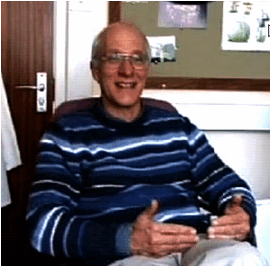
When I
viewed this video clip, I was so inspired by what Rayner had said and
demonstrated that I emailed him and a series of emails between us followed. In
one of the emails, I express the following which relates to my understanding of
inclusionality and my inclusional way of being:
When I was a teacher, this is
something I valued – never authoritarian
but enjoying the flow of
interaction between teacher/learner, learner/
teacher, all learning together,
co-creating, reflecting and connecting
through the participation of all.
Not only as a teacher, but within my life
and with whom I relate, I enjoy,
feel and grow from this flow of interaction and participation.
(Email
sent 26 January, 2006)
In my job
as an Inclusion Officer, I see inclusionality being demonstrated within some of
the school communities with whom I work. In fact, I would go as far as to say
that in truly inclusive schools, whereby inclusion is seen as a fundamental
value within the school, inclusionality is being demonstrated throughout,
between pupil and pupil, adult and adult and pupil and adult. This has been a significant shift in my
learning and understanding as I am now able to articulate what a truly
inclusive school is. It is not only to do with inclusive practices and policies
being in place; it is to do with the inclusional way of being within the school
community.
To find
out more about inclusionality, go to Alan Rayner's website:
http://people.bath.ac.uk/bssadmr/inclusionality
My Role as an Inclusion Officer
I became
an Inclusion Officer in February, 2004 and in 2007, a Senior Inclusion Officer.
The post of Inclusion Officer was a new one and the purpose of the job as
described in my job description was as follows:
To support the LEA's inclusion
agenda, working creatively in
partnership
with schools, LEA support teams, LEA officers and
agencies such as the Health
Service and Social Services to minimise
barriers to learning and
participation in educational settings and support diversity in order to promote
a culture of inclusion in all educational settings.
(Inclusion
Officer Job Description, 25 September, 2003)
My job
description reflected the political climate at the time with further
legislation being introduced. Removing
Barriers to Achievement: The Government's Strategy for SEN (DfES, 2004)
demonstrated the government's vision for special educational needs (SEN) over
the next ten years. Four areas were identified:
·
early intervention;
·
removing barriers to learning;
·
raising expectation and achievement;
·
delivering improvements in partnership.
Every Child Matters (DfES, 2003), the Government's Green
Paper, formed the basis of the Children Act 2004, and aims to improve outcomes
for children, young people and families. The key outcomes for children and
young people are:
·
be healthy;
·
stay safe;
·
enjoy and achieve;
·
make a positive contribution;
·
achieve economic well-being.
Hayward
identifies the key elements of the Act:
·
building services around the child, young person and families to
achieve
improved outcomes;
·
understanding and responding to children's needs in a holistic way;
·
supporting parents, carers and families;
·
better safeguards for children and young people;
·
focusing on opportunities for all and narrowing the gaps;
·
developing the workforce and changing culture and practice;
·
integrating working practices, processes, strategy and governance.
(Hayward,
2006:6-7)
The Act
has had significant implications in the way that Children's Services work
together, with the Departments of Education, Health and Social Services being
brought together under a Director of Children's Service. Multi-agency working
is a key focus of the Children Act, the aim being that professionals work
together to meet the needs of children, young people and families. This,
however, is not without its challenges. Firstly, there is the challenge of
using language and terminology which is understood by all services and organisations.
Secondly, professionals working with children and families, need to be
coordinated to ensure that there is a joined up approach to the provision in
place. A 'lead professional' should be appointed to coordinate provision and to
be the single point of contact for all working with the child or young person. A
Common Assessment Framework (CAF) has been introduced which is an important
tool for early intervention whereby practitioners can assess the needs of a
child or young person. It can help practitioners develop a shared understanding
of a child's needs, so that they can be met more effectively. The Act
encourages professionals, as they work together, to look at, not only
educational inclusion but social inclusion. Children's needs are greater than
merely educational. There are influences in a child's life associated with
their family, their community, society as a whole which may make the child
vulnerable with the need to be socially included. This has been reinforced by the Education and Inspections Act
2006, which places a duty on schools to promote children's well-being. The
relationship between teaching and learning and the broader social responsibility
towards pupils is becoming more apparent. Schools should have:
a system that responds to
individual pupils, by creating an
education
path that takes account of their needs, interests and
aspirations, (which) will not
only generate excellence, it will also
make a
strong contribution to equity and social justice.
(DfES, 2005)
The
Children Act requires local authorities to produce one plan to cover all
services which affect children and young people. In the authority in which I
work, the multi-agency Children and Young People's Strategic Partnership had
been working on a Local Preventative Strategy since 2002 to promote the health
and well-being of children and young people. The work and plans already in
progress became the basis for the authority's, Children and Young People's Plan, 2006-2009, the vision of which
is:
We want all Children and Young
People to do better in life
than they ever thought they
could. We will give children and
young people the help they need
to do this.
(Bath and North East Somerset Local Authority, 2006:2)
It was
against this background that I became an Inclusion Officer. I was pleased that
I would be working with the inclusion of all children and not only the
inclusion of children with special educational needs. I was pleased that my
focus would be with all groups that may experience barriers to learning and
participation. The remit of the post was extensive and my concern was where to
begin. I was advised to get myself on as many education, health and social care
meeting agendas as possible in order to introduce myself. I was also asked to
find out what issues there were for schools with regard to the support they
were receiving from the local authority and what issues they had with regard to
inclusion. I decided to approach SENCOs and attend SENCO cluster groups. I also
contacted various teams in the health service and social care to find out what
issues there were for them in working with schools. This action research
project gave me a focus. Contacts made at this time have continued to form
partnerships to the present day. A brief summary on all work undertaken in
these initial months was fed back to the Head of the Inclusion Service
(Appendix A).
My
learning at this time was considerable. I had moved from teaching within a
school to working full time with the local authority. The year previous to
this, I had been working part-time in school as a teacher and with the Local
Authority as an Assistant Education Officer. I was certainly beginning to feel
the 'them and us' attitude from some teachers towards the authority. Although I
was aware of this attitude as a teacher, I had not personally felt it. I had
always had a good relationship with people working in the local authority and
they with me, for example, educational psychologists, education officers,
members of the learning support and behaviour support teams. It was a surprise
to me to be challenged as a representative of the local authority by some
teachers when I attended meetings, especially in these early years, as within
me, I still felt a teacher; I still felt a special educational needs coordinator.
Even though I was an Inclusion Officer in the local authority, my career had
always been in teaching and I was fully understanding of issues and pressures
confronting schools and teachers. Even now, I am still taken aback when
challenged, and perhaps naively, still surprised by it.
At the time, besides setting up courses and running workshops, I
was also researching into an Inclusion Chartermark for the authority. My job description stated that as
an Inclusion Officer, I was:
To lead on the establishment of a
Bath and North East Somerset
Inclusion Standard (Kitemark) and
set up a system to reward early
years settings and schools who fulfil our standard.
(Inclusion
Officer Job Description, 25 September, 2003)
When I
first read this statement, I did not perceive this aspect of the job to be a
difficult one. After about a month into my exploration, I started to realise
what a mammoth task this was. I felt overwhelmed and anxious and questioned my
ability to undertake such a responsibility. I did not realise, at the time,
what a huge impact on my learning, both personally and professionally, was to
take place in the ensuing years as I endeavoured to work towards the
implementing, developing and evaluating the Bath and North East Somerset
Inclusion Quality Mark.
The Bath and
North East Somerset Inclusion Quality Mark
I began
to investigate what Inclusion Standards were around in the various authorities.
I was aware of the Birmingham, Standards
for Inclusion (Birmingham City Council, 2002) and the Bristol, Inclusion Standard (Bristol City
Council, 2003). I obtained these documents and spoke to the lead people in the
authorities. At the time, I was also considering the possibility of developing
our own standard. This had been the case in Bristol and Birmingham. I began to
investigate what other authorities were doing. I also started exploring what
information the Department for Children, Schools and Families (DCSF) and
TeacherNet, the education website for teachers and school managers had, and started
searching the internet for more information on Inclusion Standards. It was at
this point that I realised the difficulty of the task. I could not find any
information on Inclusion Standards. To my surprise, it seemed that Inclusion
Standards were not a priority in the authorities.
After
much researching and accessing various authorities' action plans, I was able to
identify some authorities which were involved in the development of Inclusion
Standards. I contacted the lead person in each of the authorities and they gave
me access to the Inclusion Standards they had developed. Looking through the
various Inclusion Standards, all seemed very similar with schools having to do
an audit of their inclusive practice, developing an action plan and providing
evidence of inclusion and its development in their schools. I then came across
a book called, The Inclusion Quality Mark
(Coles and Hancock, 2002), through a SENCO forum on the internet. I sent
away for a copy and when I read through it, I felt that it was just what we
wanted. It was what I had been looking for. It built on documents such as the Index for Inclusion (Booth et al, 2000) and
Inclusive Schooling (DfES,
2001a). It was also in line with Ofsted expectations. It consisted of ten
elements focusing, not only the school but parents and carers and the community
and included guidance on each. Most of the elements were divided into school
evidence, staff evidence and pupil evidence. The fact that there was an
emphasis on pupil evidence, I found to be really encouraging in that there was
an emphasis and recognition that the pupil, their needs and rights are at the
core of what we do. An audit was provided for schools to identify strengths and
areas for development. What really excited me about, The Inclusion Quality Mark was that authorities could adopt it and
develop their own systems and processes and put their own stamp on it. In such
cases The Inclusion Quality Mark
would be named after the authority, thus The Bath and North East Inclusion
Quality Mark. At the time, I contacted Caroline Coles through emails for
clarification on a number of issues.
The Inclusion Quality Mark, I felt, provided us with an
infrastructure which was all inclusive and one with which I could work with and
develop. I did not want the awarding of the Inclusion Quality Mark to schools
to be the result of ticking the right boxes. I wanted the Bath and North East
Somerset Inclusion Quality Mark to be a reflection that inclusion was alive and
living in schools. I wanted it to reflect that inclusion was a core value
within the school (Corbett, 2001) and that this drove everything within the
school; that when going into a school that this core value of inclusion was
palpable and could be felt throughout. I wanted
to see and feel the school community working inclusionally and demonstrating
the values of inclusionality. It was at this point, when I became aware of what
I wanted the Inclusion Quality Mark to be, that I felt energised. It is this
awareness that has driven me in the development of the Inclusion Quality Mark
in the authority.
In this
chapter, I have described my developing understandings of inclusion and my
introduction to inclusionality which has had a significant impact on me in my
role as an Inclusion Officer. I have described my role as an Inclusion Officer
against the legislative background on becoming an Inclusion Officer. Finally, I
have described the evolvement of the Bath and North East Somerset Inclusion
Quality Mark.
CHAPTER 3 - METHODOLOGY
AND METHODS
In this chapter, I relate to the action research
approach I have used as I inquire into my question, 'How do I improve my
practice as an Inclusion Officer?' In doing so, I describe the methodology and methods
that I have employed and explain my reasons as to why I have adopted a living
theory methodology (Whitehead, 2008a).
Methodology
Through adopting a living educational theory methodology, practitioners create their own educational theories by embodying their educational values in their practice. Whitehead (1989, 2003) claims that values are embodied in our educational practice and that in using our values as living standards of judgement we can judge the validity of our claims of educational knowledge.
The living theory methodology is distinguished from other methodologies by its inclusion of 'I' whereby the 'I' becomes a living contradiction between the educational values that are held and the negation of those values in the practice of a practitioner (Whitehead 1989). To clarify further, the 'I' becomes a living contradiction when the values that we hold and aspire to are not being lived in the work we are doing. In asking the question, 'How do I improve my practice?' there is a desire to live our values more fully in our practice. If we find we are not doing this, and our practice is, in fact, denying our values, we may experience ourselves as a 'living contradiction'.
The living theory methodology to my self-study emphasises the importance of asking, researching and answering questions of the kind, 'How do I improve what I am doing?' This does not deny the importance of social relationships; rather it stresses the importance of asking such practical questions. This methodology, however, differs from participatory action research as the latter usually begins with the assumption of a community working on a common problem.
My ontological assumptions are that I see myself as a part of other people's lives and they, a part of my life; I do not see myself as separate, as an observer or an outsider as would be more the action research approach of the social sciences, whereby descriptions and explanations are offered for what others are doing. Likewise, my epistemological assumptions are that I see knowledge as something which the individual creates for themselves and with others; I see myself as a part of knowledge creation.
My choice of a living theory methodology is
based on my desire to make a contribution to the knowledge of inclusionality
and the processes of improving inclusionality in schools. As a
practitioner-researcher with responsibilities for helping to promote and
develop inclusive practice in schools and for awarding schools with the Bath and North East Somerset Inclusion Quality Mark, I wish
to publicly communicate my knowledge in a way that can be accredited by a
Higher Education Institution as worthy of a masters degree.
I find the living theory methodology
exciting and creative. Practitioner-researchers have focused on bringing their
knowledge into the Academy in their successfully completed doctorates, such as,
'A living theory of a practice of social justice: realizing the right of
Traveller children to educational equality' (Sullivan, 2006), 'How can I
improve my practice as a superintendant of schools and create my own living
educational theory?' (Delong, 2002), 'How can I create a pedagogy of the unique
through a web of betweenness?' (Farren, 2005), to name just a few.
The
methodology I use is strongly influenced by my ontological and
epistemological assumptions (Hitchcock and Hughes, 1995). In conducting my
research I see myself as a part of the world and interacting with others and
thus creating new knowledge individually and together. As explained previously
and to clarify here, there are fundamental differences between the ontological,
epistemological and methodological assumptions of a living theory and a social
science methodology. The ontological assumptions of the interpretive action
researcher put the researcher as separate from the practitioners they are
studying. The assumption of living theory researchers is that the individual
decides how they are going to conduct their research and how they should live
their lives in negotiation with like-minded people (Whitehead and McNiff,
2006).
Cresswell
(2007) describes five qualitative research methodologies and reviews the
similarities and differences between them. They include narrative research,
phenomenological research, grounded theory research, ethnographic research and
case study research. Whitehead (2008b) describes the similarities and
differences between each of these methodologies and the living theory methodology.
Whilst living theory has similarities to each of them, the fundamental
difference between them all is that a living theory is a researcher's unique
explanation of their educational influences in their own learning, the learning
of others and the learning of social formations. Regarding narrative research,
Whitehead states that whilst all living theories are narratives, not all
narratives are living theories. The purpose of living theory is not to give a
description of universal essence as in phenomenological research; it is not to
give abstract generalizations as in grounded theory research, it does not focus
on a culture group as in ethnographic research and is not constrained by a
bounded system as in case study research.
Newman
(2000), in discussing action research states that there is 'no one 'right way'
of doing action research. Practitioners engaging in these more open,
reflective ways are inventing methodology as they go along.' Corbett, in her
research of inclusion in a London school, found that she learned about the
methodology of researching inclusive education and inquires as to whether it
requires a new research methodology. She states:
To my surprise in what I thought
would be a practical case study,
this theoretical challenge to
research methodology became one of
the integral components of the
book. If we accept that inclusion
is a philosophical concept which
requires an examination of ethics,
equity and justice, this can be
supported by an emancipatory approach
which has empathy at its core.
(Corbett,
2001: 8-9)
Whitehead
(2008a) refers to 'methodological inventiveness' as described by Dadds and Hart
whereby practitioner-researchers develop their own unique way through their
research:
No methodology is, or should be
cast in stone, if we accept that
professional intention should be
informing research processes,
not pre-set ideas about methods
of techniques.
(Dadds and Hart, 2001:169)
As
mentioned previously, the difference between a living theory methodology and
other forms of research is the inclusion of the 'I' as a living contradiction
with regard to the inquiry and the explanations of educational influence in
learning. In living theory methodology and the development of the individual's
living educational theories, the meanings and experience of embodied values of
humanity are transformed into living epistemological standards of judgement.
Accounts can thus be produced that explain the individual's educational
influence in learning. Besides this, individual's give explanations of their
educational influence in the learning of others and in the learning of social
formations. To clarify, in the living theory methodology, improvement and
justifying claims to know (a 'prove' agenda) are not seen to be opposed.
Methods
When the
decision has been made as to what research is to be undertaken, consideration
needs to be given as to what data and evidence is required. Such questions may
be asked such as, 'What do I need to do and why?', and, 'What is the best way
to collect information and what shall I do with it?' (Bell, 2003). There are
many choices about monitoring practice and gathering data and there may be a
combination of the various methods. Methods may be written or live (McNiff and
Whitehead, 2005). Written methods may include field notes, keeping a journal or
diary, doing surveys, record sheets of tables and charts, questionnaires,
whilst live methods may include interviews, and audio and video recordings.
Action Reflection Cycles
Action research is based on change-action and is cyclical in nature. It involves stages of action and research, followed by action. It involves the identification of a problem, collecting information, analysing, planning actions and implementing and monitoring outcomes. It was originally developed by Lewin (1946) and further developed by Schon (1983), Carr and Kemmis (1986) and Whitehead (1989).
Eisner
(1988) addresses the politics of method and its effects on the character of
educational research. He questions how the research methods we use may shape
what we can learn about educational practice and the degree of the forms we
employ to describe what we have learned and how these constrain what we are
able to say; also the extent of our conceptions of knowledge and belief, art
and science, truth and falsity and how these conceptions may influence how we
go about our work. He believes that the answers to these questions have
profound implications to the future of educational research.
In the use of action reflection cycles developed
by Whitehead, researchers ask questions of the kind, 'How do I improve my
practice? How do I Improve what I am doing?' and 'What is the educational
influence in my own learning, in the learning of others and the learning of
social formations?' (Whitehead, 2005).
Narrative Inquiry and
Action Reflection Cycles
In this
self-study, as I inquire into my practice and make my claim to educational
knowledge, the processes of data gathering involve the action reflection cycles
and forms of narrative inquiry advocated by McNiff (2007). Narrative inquiry is
linked to the action research process by practitioner-researchers telling their
stories.
Narrative
inquiry is quite a recent movement in qualitative research and has emerged as a
discipline within the broader field of knowledge management. Clandinin and
Connelly (2000) defined it as a method, however, Clandinin (2007) developed it
into a methodology that uses such methods as letters, conversations,
autobiography, family stories, life experiences, photos, interviews, field
notes and stories. Dewey's (1938)
influence in this field cannot be doubted. He informs narrative inquiry in
terms of the nature of experience. His view of experience is that no one and
nothing exists in isolation; that experience has both a personal and social
meaning and that individuals should be analysed as part of a social group and
as individuals. Dewey sees experience as being on a continuum which is shaped
by past experiences and continues to shape those that come after. Rossiter, in
reference to a narrative approach to adult development states:
In most general terms, we can say
that a narrative approach
to development looks at the
storied nature of development
and considers story as a metaphor
for human life.
(Rossiter,
1999:59)
McAdams (1985),
in focusing on identity formation, states that the outcome of the process of
identity formation which proceeds throughout adulthood, is a dynamic, evolving
life story. Identity, like
narrative, is an unfolding of self through time and involves a temporal
movement. He states that an individual is given a sense of continuity necessary
for identity formation through the integration of past, present and future into
narrative.
Connelly
and Clandinin (1999) refer to teacher knowledge in terms of narrative life
history. They state that the stories or narratives of experience are social in
that they reflect the contexts in which teachers live, and personal, as they
reflect a person's life history. Connelly and Clandidin (1988) have coined the
term, 'personal practical knowledge' which refers to teachers, through their
experience of the past, the present and their projections for the future, as
being knowledgeable and knowing persons. They are knowers of teaching, learning
and their subject matter, and knowers of their situation, their children and
themselves. This connects very much with Snow's (2001) idea of teachers, in
that they possess a wealth of knowledge about teaching, based on their personal
knowledge and personal experience, as expressed previously.
In
telling my story, I focus on my personal knowledge and experience as an
Inclusion Officer. I describe what I have done and how this has led to the
furthering of my learning. I describe how reflecting on my learning leads to
new learning and action. I describe and explain my practice. I tell my story
and reflect on my learning as I work with other educators in a Children's
Service and schools.
Video
Throughout
my inquiry, I have used video in order for me to reflect on my practice (Farren
and Whitehead, 2006). Eisner (1993) explains that the relevance of different
forms of representation in research is growing and gives the example that film
is a means of understanding aspects of schooling and that schools of education
need to develop training on how this can be used.
Using
video has given me another dimension in which to reflect on my practice in a
way no other form could achieve. As I watch the video clips, I am looking for
evidence of my inclusional way of being and my recognition of the inclusional
way of others, in the way that I relate to them, in the way that they relate to
me, in the way that we relate to each other demonstrating qualities of
genuineness, honesty, care, trust, loyalty and respect. I show the video clips
to colleagues and ask them if they can see this evidence of which I am seeking.
I ask whether the video clips demonstrate and communicate my living values. The
video clips I present in my dissertation can be accessed by clicking on the
links and are accompanied by still images. Still images can be seen throughout
my dissertation. A CD of the selected video clips is included with a hard copy
of my dissertation. The validity of multi-media accounts can be established
using the criteria of social validity as described by Habermas (1976) and
clarified below. The originality of my qualitative findings is in the way I am
clarifying the life-affirming energy with my inclusional values in my
explanations for my practice as an Inclusion Officer.
Reflective Journal
Throughout
my inquiry, I have kept a research reflective journal whereby I have reflected
on actions made and kept a record of my evolving thinking. I draw on extracts
from my journal identifying experiences in my practice, critical incidents, and
my learning and progress to further action.
Validity
How do I
know that my claim to knowledge is valid? What criteria do I use in making
judgements of my claim to know? This is a self- study of my practice whereby I
am reflecting on my learning, thus it would seem that the traditional criteria
of generalisability and replicability (Sullivan, 2006) used in traditional
research may not be appropriate. Schon refers to the dilemma of rigour or
relevance:
People
tend to feel the dilemma of rigour or relevance with
particular
intensity when they reach the age of about 45. At
this
point they ask themselves, "Am I going to do the thing I
was
trained for, on which I base my claims to technical rigour
and
academic respectability? Or am I going to work on the
problems – ill-formed,
vague and messy – that I have discovered
to be
real around here?" and depending on how people make
this
choice, their lives unfold differently.
(Schon, 1995: 28)
McNiff (2002) argues that in action research, practitioners, not 'the
experts' set their own criteria as they take responsibility for their own work.
In action research, she states that the values that inform practice become the
criteria for judgement. Hartog, for example, in her living theory thesis,
demonstrates how to do this. She sets out the criteria she uses to explain her
own practice and relates these to the criteria the university uses to recommend
the award of a doctorate:
The
aim of this thesis is to present a storied account of my inquiry,
in which I explore what it means to live
my values in my practice.
Through
descriptions and explanations of my practice, this thesis
unveils a process of action and reflection,
punctuated by moments
when I deny or fail to live my values
fully in practice, prompting
the iterative question 'How do I improve
my practice?', the reflective
process enabling me to better understand
my practice and test out
that understanding with others in the
public domain.
(Hartog,
2004:2)
Evidence then needs to be produced from data
that meet the criteria. This evidence is used when practitioners claim that
their learning has improved. McNiff then suggests that the practitioner's
judgement of their work needs to be critically scrutinized by others such as a
critical friend and a validation group. Whitehead (2008a), too, postulates that
living theory methodology involves both personal and social validation. In
conducting my research, I use personal and social validation as advocated by
McNiff and Whitehead. I will be drawing on Habermas' four criteria for social
validity. Habermas states that in communication between speaker and hearer, in
order to reach an understanding between the two, the following validity claims
must be raised:
·
The speaker must choose a comprehensible expression, so that speaker and
hearer can understand one another.
·
The speaker must have the intention of communicating a true
proposition so that the hearer can share the knowledge of the speaker.
·
The speaker must want to express his intentions truthfully so that the hearer
can believe the utterance of the speaker.
·
The speaker must choose an utterance that is right and can agree with
one another in the utterance with respect to a recognized normative background.
(Habermas, 1976: 2-3)
Whitehead postulates that Habermas criteria for social validity can be
used to judge the validity of writing and reading a text, as these are a form
of social communication. He thus suggests that the following questions can be
asked in relation to these criteria:
·
Is the account comprehensible?
·
Is the account truthful?
·
Is the account sincere?
·
Is the account appropriate?
(Whitehead and McNiff, 2006:141)
Validation Group and
Critical Friends
Each week, we hold a Conversation Cafe whereby people working in the
Bath and North East Somerset Children's Service meet to discuss their practice
and discuss ways as to how they can improve their practice. We have been
meeting for about three years and at present, we meet every Thursday morning at
8 o' clock for an hour. Jack Whitehead, Bath University, joins us every week. We
begin by telling the group of experiences that are exciting us in our work. Throughout
the session, we express concerns when we feel that our values are being negated
in our practice. Frequently, we take along our writings, show it to the group,
and they comment and act as critical friends. Throughout my inquiry, I have
taken my writings along to this group and they validate what I am expressing
and act as critical friends. I have made a note of relevant quotations made
during our conversations and have included some in my dissertation. At times,
when I have been stuck with my inquiry, I have discussed this with the group
and they have offered suggestions as to how I should proceed. Sometimes, my
critical friends have written about me and how they perceive me in my practice.
Their writings have helped me move through difficult times in my inquiry. I
quote from their accounts in my dissertation. Such accounts, written by my
administrative support, Sandra Harris and my line manager, Nigel Harrisson and
can be found in Appendices J and K. I have used this group as a validation
group to see if what I am saying has validity. A transcript of a validation meeting held on July
17, 2008 can be found in Appendix F.
At this point, I would like to
emphasise that Conversation Cafe is not a focus group in the traditional sense.
Powell et al define a focus group as:
A group of individuals selected
and assembled by researchers to
discuss and comment on, from
personal experience, the topic that
is the
subject of the research.
(Powell et al, 1996:499)
Conversation
Cafe consists of colleagues who meet to discuss their practice, how they can
live their values in their practice and what they can do when their values are
being denied in their practice. Individuals are not selected; there is no
moderator or agenda as may be in the traditional focus group. The focus for
discussion emerges throughout the session. Sometimes sessions are planned as
and when it is felt appropriate. The aim of the group is not to contribute to
social research as may be the aim of a focus group but moreso for each
individual in Conversation Cafe to focus on questions such as, 'How can I
improve my practice? What is my educational influence in my own learning, in
the learning of others and the learning of social formations?'
Other forms of data
Throughout
my inquiry, I have quoted from emails, evaluations from workshops and extracts
from reports that have been written on schools working towards or having
achieved the Bath and North East Somerset Inclusion Quality Mark.
Analysis
of Data
The
analysis of my data is in line with other living theory accounts. Thus, I focus
on the generation of valid explanations of my educational influences in my own
learning and in the learning of others as I explore the implications of my main
question, 'How do I improve my practice as an Inclusion Officer working in a
Children's Service?' As I clarify the meanings of my ontological values as they
emerge in my practice, they form into the explanatory principles to explain why
I am doing what I am doing. My learning, in making my values public and
communicable, as explanatory principles, is my main finding as I work at
bringing my embodied knowledge as an Inclusion Officer into the Academy as a
contribution to academic and professional knowledge.
In analysing
my data, I look for those interactions and quality of relationships which
demonstrate a desire to live such values as care, trust, loyalty as described
previously. I select from my data the appropriate evidence to support my claim
to knowledge and that shows the educational influences in my learning and in
the learning of others which is based on my values and what drives me to do
what I do.
Ethical
Issues
I have conducted my research within an ethical framework that respects
all participants and respects the acquisition and discovery of new knowledge.
It also respects democratic values and gives respect for the quality of
educational research (BERA, 2004). Whitehead and McNiff (2006) give advice
about ethical frameworks and state that there are three basic categories, the
first being access whereby if you are involved with other participants then
their oral and written permissions need to be negotiated, and if participants
are young or vulnerable, then such
permissions are needed from the parents or carers. The second category is about
safeguarding rights whereby confidentiality is assured and that participants
have the right to withdraw at any time and data destroyed. Thirdly, it is about
maintaining good faith whereby ethics' statements should be drawn up and
letters of permission written. Hitchcock and Hughes (1995) agree that there needs to be a
rapport, trust and confidence between the researcher and participants. These
qualities can be related to the ethical guidelines of the British Educational
Research Association to which I am adhering. For example, the participants are
anonymised or identified in the text depending on their choice. The process of
subjecting accounts to the scrutiny of a validation group is transparent and
designed to enhance trust and confidence in the openness and responsiveness of
the researcher to critical judgements.
In approaching participants for consent, they were informed that I was
conducting my research as an Inclusion Officer with the view of improving my
practice. As I was using video data as evidence for much of my research, I was
particularly aware of the sensitivity that this may be to some of the
participants. Initially, I requested their verbal consent to use the video camera and this was
followed up with a Research Brief (Appendix B) describing the aims of my
research and setting out my
research ethics which included informing the participants of their right to
withdraw at any time. Attached to this was a consent form which participants in
my research were asked to sign.
In this chapter, I have described the methodology and methods I have
used as I inquire into my question, 'How do I improve my practice as an
Inclusion Officer working in a Children's Service?'
CHAPTER 4 - NARRATIVES OF LIVING
MY PRACTICE AS AN INCLUSION OFFICER
My interactions and my relationship with people are crucial in how I
have developed personally and professionally. I believe that my relationships
and interactions with others have had a big impact on my development as an
Inclusion Officer and continue to do so. In this chapter, I am going to present narratives which show how my relationships and
interactions with others have had an impact on my educational influence in my
own learning, in the learning of others and the learning of social formations
(Whitehead, 2005). My narratives
relate to a variety of experiences I have encountered as an Inclusion Officer
and demonstrate values that have come to act as living standards of judgement
(Whitehead, 2005). These narratives demonstrate the nature of inclusionality
(Rayner, 2006a).
The first three
narratives, which I describe briefly in this chapter, the full accounts of
which can be found in Appendices C, D and E, demonstrate the inclusional way in
which I like to work with others. Firstly, I describe the development of a course
for new special educational needs coordinators (SENCOs), secondly, I describe a
creativity workshop at a SENCO Forum which I led with a colleague and thirdly,
I describe an emotional literacy workshop at an Emotional Literacy Conference
which again I led with a colleague. In this chapter, I refer to each of these,
describe them briefly and summarise my standards of judgement which derive from
the values I hold. I then specifically focus on three narratives which
exemplify inclusionality through my work on the Bath and North East Somerset
Inclusion Quality Mark.
Throughout these
narratives, I show video clips and describe what I am seeing as I look at the video
clips, I quote extracts from my reflective journal and comments made at Conversation
Cafe, including extracts from a validation meeting held on July 17, 2008. I
also include extracts from evaluations of workshops and emails I have received,
and an extract from a school's Inclusion Quality Mark assessment report.
Development
of a Course for New Special Educational Needs Coordinators (SENCOs). A Summary
My first narrative
(Appendix C) describes a course which I have run for new SENCOs for the last
four years. I decided to run the course in response to SENCOs who felt
frustrated as there was no training in place to develop their skills and
knowledge. In the narrative, I reflect on my learning and describe the
inclusional way in which I like to work with others and the 'mesh of
relationships' between the SENCOs, members of the Inclusion Support Service and
personnel from Bath Spa University. I believe that my inclusional way of
working with others, not only contributed to the success of the course, but has
been fundamental with regard to other initiatives I have implemented as an
Inclusion Officer. Evaluations describe the learning of the SENCOs in
participating on the course and how it equipped them to do their job better.
In reflecting on
this narrative, I now summarise my standards of judgement that derive from the values I hold which
have been demonstrated in the development of this course:
·
Being receptive to the needs of SENCOs and enabling
them to develop skills and knowledge, through setting up a course for SENCOs;
·
Working collaboratively with other educators in
Children's Service and Higher Education in developing a course for SENCOs;
·
Being able to reflect and value the response of
others in working together on the course for SENCOs;
· Recognising and valuing the solidarity in the mesh of relationships.
Creativity Workshop, SENCO Forum, Bath and North
East Somerset, June 2006. A Summary
My second narrative
(Appendix D) describes a creativity workshop which I led with a colleague. In
running this workshop, we wanted to co-create with each other and participants
in the workshop, a creative environment whereby participants could develop
their own understandings of creativity. It was such a risk as it involved the
participants being a part of the co-creation.
In the
narrative, I refer to an account which I wrote at the time when I reflected on
video clips of the workshop and describe how I felt as I watched the clips. I
then describe my learning as I reflected later on my account and the video
clips.
The narrative
demonstrates the inclusional way in which I like to work with others and the
excitement I felt at the time in running the workshop. Evaluations describe how
much the participants enjoyed the workshop, how much they learnt from it and
one in particular which stated that the learning from the workshop would feed
into their whole school approach on creativity.
In reflecting on
this narrative, I now summarise my
standards of judgement that derive from the values I hold which have been
demonstrated in the running of this workshop:
·
Being prepared to take risks and even the risk of
failure and encouraging others to do the same;
·
Recognising the value of working with others and
enjoying each other for who we are, interacting, reacting and co-creating
together;
·
Developing ways of being able to learn from others,
to learn together and to be open to all possibilities;
· Working collaboratively with others and sharing the excitement and exhilaration of working creatively together.
Emotional
Literacy Workshop, Emotional Literacy Conference, Bath and North East Somerset,
October 2006. A Summary
My third
narrative (Appendix E) describes an emotional literacy workshop which again I
ran with my colleague. In the running of this workshop, we wanted to create an
emotionally literate space whereby participants would develop their own understandings
of emotional literacy.
Again, I
describe what I am feeling as I reflect on video clips of the workshop. In this
narrative, I refer to two stories in particular, described by two of the
participants when they felt that there had been an emotionally literate space
in their classrooms. I describe
the connection I feel with them and my inclusional response which I felt at the
time and as I reflect on these video clips.
Participants
thoroughly enjoyed the workshop and learnt from it as indicated in the
evaluations. The workshop demonstrates the inclusional way in which I like to
work with others.
In reflecting on
this narrative, I now summarise my standards of judgement that derive from the values I hold which
have been demonstrated in the running of this workshop:
·
Being responsive to the honesty and integrity of
other educators in relating their stories of inclusionality;
· Working collaboratively with others in co-creating an emotionally literate space.
The next three
narratives focus on my work with regard to the implementation and development
of the authority's Inclusion Quality Mark. A
validation meeting (Appendix F) was held on 17 July, 2008 with colleagues where I presented the following three
narratives, The Pilot of the Bath and North East Somerset Inclusion Quality
Mark, The Role of Mentors and Assessors and The Recognition Ceremony. Using
Habermas' criteria for social validity as a structure and as described in Chapter
Three on Methodology and Methods, I include relevant quotes from that meeting
throughout my narratives.
The Pilot of the Bath and
North East Somerset Inclusion Quality Mark.
In
this narrative, I wish to emphasise how the schools, the mentors and assessors
in the pilot, contributed towards the co-creation of the Bath and North East
Somerset Inclusion Quality Mark.
Eight
schools participated in the pilot. The pilot lasted for a year. It was during
this time that I wanted to try out various processes and for the schools in the
pilot to be a part of the evaluation of these processes. I wrote at the time:
I feel it important
that schools through being co-reflective are a
part of the co-creative development of the Bath and North
East
Somerset inclusion Quality Mark.
(Reflective Journal, 8 September, 2004)
Again,
I wanted to work inclusionally with schools and develop our understandings
together. At the first workshop, we evaluated the significance and value of the
questionnaire which schools had sent out to a small cross-section of the school
community. We also evaluated the significance of the audit, action plan and the
day visit of the mentors. Schools and mentors worked together in small groups
and discussed each aspect.
In short,
schools were very supportive of the processes in place. Their feedback was
important to me and I was prepared to make any of the necessary amendments that
would be beneficial. Much discussion took place at this workshop about how much
evidence should be included in the portfolio. A significant cause of concern for
the schools was about the sort of evidence that was required in their
portfolios. Whilst there was guidance in The
Inclusion Quality Mark (Coles and Hancock, 2002), it was felt that further
clarity was needed. It was agreed that at the following workshop, schools would
discuss the evidence they had in their schools and decide what could be used in
their portfolios. After the workshop, I wrote the following:
I am very pleased with the
outcome of the workshop and things
moved further on than I had
expected. The schools are actually contributing to what evidence is required and
seem excited as to
their involvement.
(Reflective Journal, 17 March, 2005)
This was a significant step forward for
me as schools were actively involved in developing the Bath and North East Somerset
Inclusion Quality Mark.
At the second
workshop, schools and mentors were divided into five groups and each group
worked on two elements. Schools considered their evidence and recorded this in
the elements on which they were working. Schools were encouraged to include any
local initiatives in which they had participated. By the end of the session,
each group had completed the task. The final document was typed up having been circulated to all after the workshop for
additions and amendments to be made.
This
was a really exciting time for me as a space had been created for schools to
work together to produce something of value to them which they could use in
working towards the award. This document is now given to and used by all
schools when working towards the award.
In reflecting on
this narrative, I now summarise my standard of judgement that derives from the
values I hold which have been demonstrated through this narrative:
·
Developing ways that educators in a Children's Service and schools
can work together inclusionally in a co-reflective, co- creative way,
contributing to
the development of the Bath and North East Somerset Inclusion Quality Mark.
The
Role of Mentors and Assessors in the Bath and North East Somerset Inclusion
Quality Mark
I would now like
to clarify the role of mentors and assessors and
highlight their significance. As I do this, I shall give some examples of
comments made about my practice and about the roles of mentors and assessors
which reflect the values I hold in working inclusionally with others.
The
role of mentors and assessors in the Bath and North East Somerset Inclusion
Quality Mark is significant and is a reflection of the inclusional way in which
I like to work. It was stated at the validation meeting:
You (are) showing
over time, and I think it's so clear that you are,
that you are seeking
to live your values as fully as you can, you
know, interacting all
the time with others.
(Validation meeting, 17 July, 2008)
As I
have said previously, I do not want the achievement of this award to be the
result of ticking the right boxes. I want to see inclusive practice as being
alive and living in schools. I want to see schools, as a community, working
inclusionally. When I refer to the term, community, I am referring to all
stakeholders: the head teacher, teachers, teaching assistants, school meals
supervisory assistants (SMSAs), pupils, governors, parents and administrative
staff. What are the qualities of relationships like in the school? Does
everyone have a voice? Do all feel included? Does everyone feel valued?
I
would now like to show a video clip of a discussion I am having with the
audience when a colleague and I presented our paper (Jones and Huxtable, 2006) at the BERA Conference, 2006, at Warwick University. As
I watch myself in this video clip, I see myself explaining what we look for
when we go in to schools; the relationships between one and the other. As I
watch the video clip, I can feel the passion with which I spoke at the time and
I feel that passion now. I am connecting with the audience and imparting the
value I feel in ascertaining the quality of relationships in a school.
Plate 3:
Chris at the BERA Conference, 2006
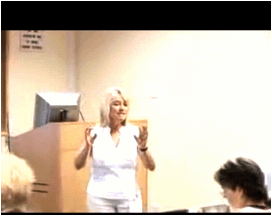
CD 3. Chrisbera06.mov (move cursor to 2.04 mins and
stop at 3.35 mins)
It is with this
energy that I like to work with schools and colleagues in developing the Bath
and North East Somerset Inclusion Quality Mark
Mentors
work with schools as critical friends supporting them to achieve the award. When
a school chooses to work towards the award, two mentors are assigned to the
school and initially spend a day meeting a cross-section of the school
community to find out their understandings of inclusion, to determine the
extent of inclusive practice and to determine the quality of relationships.
When it comes to the final assessment, two assessors also visit the school for
the day, meeting a cross-section of the school community. Recently, I received
this email from a teacher following a day visit to the school as an assessor,
after a colleague and I had observed a classroom lesson:
I'd just like to say
thank you to you from me and class 7
to you and Liz
yesterday. Being watched is never my favourite occupation, but there was
something about the friendly way the
pair of you came in
and turned it into something else….I stopped feeling that I was about to be
under scrutiny - and it was something your positive energy created. Instead, I
felt that you had come to appreciate the children I was teaching for the people
they are, rather than they were SATs statistics or targets. It was as if we
were welcoming you to our home and saying 'this is us and we're pleased to see
you'.
(E
mail sent 13 Feb, 2008)
At
the time, I wrote in my journal:
I am really pleased
to receive this email because, as a mentor
and assessor, I want
schools to feel supported. When I walk
into a classroom, I
do not want to be impositional. I want to be a
part of the classroom
experience; to learn with the class and from
the class.
(Reflective
Journal, 15 Feb, 2008)
The
lesson we had observed was excellent and the relationship between the teacher
and pupils was warm, respectful of each other and caring. It was a pleasure and
humbling to have been a part of this experience. The write-up of the day visit included
a comment on the quality of relationships which we observed in that lesson of
which we had been a part:
Pupils felt that all the teachers were very
approachable and this
was obvious in the Year Five, forty five minute
music lesson observed. The relationship between the class and the teacher
was one of respect. The learning objective was
clearly stated
and displayed, and talking to students revealed
that they were clear about their task. All pupils remained focused, worked co-operatively
and valued each other's contributions. They clearly enjoyed the session, which
concluded by performances from each group.
(Extract from report sent to a
school following a day visit, 14 February, 2008)
Mentors
work with the school throughout the process, feeding back on the day visit and
advising on ways forward, validating their audit and action plan, advising on
their portfolios and their readiness for assessment. The role of mentors is a
crucial aspect in the Bath and North East Somerset Inclusion Quality Mark.
Schools have commented on the support they have received:
We're naturally thrilled with the
news that we've been awarded
the IQM quality mark. Thanks go
to you and your team for the
superb support and guidance we've
received throughout. The
verification of quality practice
and constructive suggestions for
further improvements have been
very supportive and well received
by the whole school
community.
(E mail sent 4
March, 2008)
I would now like
to show a video clip of Antony Wainer who was the lead teacher in his school on
the Bath and North East Somerset Inclusion Quality Mark. I had been one of the
school mentors. I invited Antony
to do a presentation on his school's experience to representatives of schools
interested in working towards the award. In this particular video clip, Antony
is telling representatives about the role of mentor. I chose this video clip of Antony because it shows his inclusional
way of being in the way that he communicates with his audience. I have seen
Antony present many times and he has the ability to draw people in; he has a
presence which is inviting and including of all.
Plate 4: Antony at the Bath and North East Somerset Inclusion Quality
Mark Presentation

I feel that what
Antony says, sums up the role of mentor in that
mentors are there to be supportive, not to be judgemental. Mentors are there to
be critical friends. Antony continued to comment on the action plan; that
suggestions were made at first that the school did not feel may be relevant or
appropriate but after consideration felt a good point had been made.
A
cross-section of colleagues in the authority volunteer to become mentors and
assessors. Staff of schools that have achieved the award are also encouraged to
be a part of the team. Antony is now a mentor and assessor. As a team, we support each other. This
is really important me, as I stated in my journal:
I feel a tremendous
support from the mentors and assessors. I could
not do this work
without them. This is the way I like to work
with colleagues. We work in pairs when we visit schools,
several meetings are
held throughout the year so that we have
the opportunity to
discuss our experiences and to share our concerns.
(Reflective
Journal, 31 January, 2008)
Recently,
I received an email from one of the team after I had sent her an email from a
school appreciating her input:
Thanks Chris
It is lovely to be appreciated!
Many thanks for coordinating and
making it such a team affair. I
look forward to more of these
positive experiences.
(E mail sent on
4 March, 2008)
One
of my biggest concerns in implementing the Bath and North East Somerset
Inclusion Quality Mark is addressing challenges presented to us when other
educators in the Children's Service and schools disagree when a decision has
been made to award a school with the Inclusion Quality Mark. Their experience
with the school may not have been a positive one; their role within or with the
school may have been such that inclusive practice and inclusionality may not
have been demonstrated or made obvious. When confronted with these challenges,
each time I ask myself, is the awarding of the Bath and North East Somerset Inclusion
Quality Mark robust, fair, just and equitable? As I reflect on this and ask
myself this question now, I can honestly say that I believe it is. I believe it
is because of the systems and processes we have in place. Before assessors go
into schools, I ask all members of the Inclusion Support Service and School
Improvement and Achievement Service, if they would like to comment on inclusion
within the school being assessed, and inform them that their responses will be
considered in the decision-making as to whether the school should achieve the
award.
If a concern is expressed, assessors
will challenge this when they visit the school. After assessors visit a school,
a Moderation Panel is held whereby all issues are discussed at length. It is
only then that the decision is made to award a school with the Bath and North
East Somerset Inclusion Quality Mark. Thus, we have a system whereby other
educators have the opportunity to express concerns, these concerns are then
explored and any issues are ultimately discussed by a panel of assessors. It is also through this process that we
develop a shared and developing understanding of inclusion and inclusionality.
The Bath
and North East Somerset Inclusion Quality Mark is growing within the authority, especially, three years on,
the initial schools that received the award are due to be reassessed. My big
concern now, as expressed at a recent validation meeting, is our capacity, with
regard to the numbers of mentors and assessors we have:
I really do need more
mentors and assessors because it's
growing…We (mentors
and assessors) meet, we've known each other; we've developed an understanding
of inclusion, inclusionality. Taking more people on means involving them,
starting with them and
their understandings and
getting their developing understandings on board.
(Validation meeting 17 July 2008)
It now seems appropriate to approach
other members of the Children's Service from education and health to be a part
of the team so that we can further develop our understandings inclusionally as to
which schools should receive the Bath and North East Somerset Inclusion Quality
Mark.
In reflecting on
this narrative, I now summarise my standards of judgement that derive from the
values I hold which have been demonstrated through this narrative:
· Developing shared understandings of inclusion and inclusionality between the mentors and assessors;
·
Developing shared
understandings and criteria as to which
schools should achieve the Bath and North East
Somerset Inclusion Quality Mark;
·
Developing systems to ensure that the awarding of the Bath and North
East Somerset Inclusion Quality Mark is robust, fair, just and equitable;
·
Developing systems to ensure that the voice of all is heard
within the
schools working towards the IQM award, for example, teachers, teaching
assistants, school meal supervisory assistants (SMSAs), administrative staff,
pupils, parents and governors.
The Bath and North East
Somerset Inclusion Quality Mark Recognition Ceremony
As I describe my reflections on
and my development as an Inclusion Officer, so I move through the process of
the Bath and North East Somerset Inclusion Quality Mark. In this narrative I
would like to clarify the significance of the Bath and North East Somerset
Inclusion Quality Mark Recognition Ceremony.
At the end of the pilot of the Bath and
North East Somerset Inclusion Quality Mark, we decided to hold a Recognition
Ceremony to celebrate the contribution that the schools made in helping to
co-create the Bath and North East Somerset Inclusion Quality Mark. The pilot
took a year to complete, in which time, six of the eight schools achieved the
award. We decided to call it a 'Recognition Ceremony' rather than an 'Awards
Ceremony' because, we not only wanted to recognise those schools which had
received the award , but also those schools which had not achieved the award at
the time but had made a significant contribution to the pilot.
In fact, before the next ceremony, in
discussions on the title, we decided that we preferred the title, 'Recognition
Ceremony' rather than 'Awards Ceremony' as it conveyed more of what the
Ceremony was about. I stated my feelings in my journal:
Whilst it is significant to receive an award, I feel it is more
significant that the ceremony is about the recognition of the contribution
that schools are making within their communities and within the authority about
the developing understandings of inclusion.
(Reflective Journal, May 25, 2007)
At the validation meeting, it was stated:
You're explaining why you've chosen recognition which feels to
me to be a new standard of judgement that you can bring through
your dissertation into the Academy.
(Validation
meeting, 17 July, 2008)
So far, we have held three Recognition
Ceremonies and what wonderful occasions they are. They are held in the
Banqueting Room at the Guildhall in Bath. The Chair of the Council and the
Council Cabinet Member for the Children's Service attend and give out
certificates and plaques to the schools. The Director of the Children's
Service, Divisional Director of the Learning and Inclusion Service and
Inclusion Support Service Manager attend and speak at the ceremony. Mentors,
assessors and other members of the Children's Service also attend besides
members of the schools' communities. Each school does a presentation on an
aspect of inclusion to a full Banqueting Room of about one hundred and fifty to
over two hundred adults, children and young people. A programme of the Recognition
Ceremony 2007 can be viewed in Appendices G (i) and G (ii).
At this point I have to commend Sandra
Harris, Administrative Officer, whose tremendous energy and hard work,
contribute to the success of the ceremony. I wrote in my journal how well all
of us as a team work together:
The day of the ceremony and the build up to it are such good
examples of how inclusionally we, as a team; mentors, assessors
and others in the authority work together. The actual Ceremony lasts
for two hours, 4.00 – 6.00. Many of us are there from 12.00 to
8.00,
setting up, preparing and
afterwards, clearing up. But it is worth
every minute.
(Reflective Journal, July 12,
2008)
I would now like to show two video clips of
presentations made by two schools at the Recognition Ceremony, July, 2008. In
the first video clip, a group of children are singing a song called, 'We Can
Live as One'. They sing about trusting one another, learning to think and
listen, and loving one another. What I like about this video clip is the energy
with which the children impart their message and how this is transmitted through
to the audience. The second video clip shows a group of children singing,
'You've Got A Friend'. They have enacted a drama of a scheme at their school
called Mate Makers, whereby children are trained to sort out problems in the
playground and to encourage children to play together. They are now singing
their song. In this video clip, one pupil is out of tune, but it does not
matter. Everyone is singing heartily and enjoying themselves. I feel that this
school is sending out a strong message and stating very clearly that they are
including of all.
Plate 5: School at
Recognition Ceremony, 2008
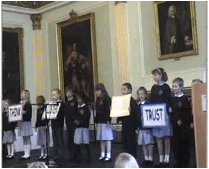
Plate 6: School at
Recognition Ceremony, 2008
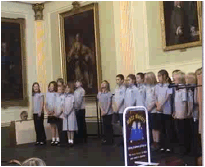
In these two video clips, I see the values I
uphold in my practice being demonstrated and expressed as living values in
these schools. I believe that this is then being transmitted to the audience
and felt by the audience. My inference may be mistaken, but this is what I feel
as they clap spontaneously after each performance.
At the ceremony, I do a presentation. I take
a long time in preparing it as I feel it important to convey the message of
what inclusion is and to impart our shared understandings; to bring together
what we mean by inclusion and how our understandings have developed. To convey
these meanings in a forum
such as this is powerful and significant in driving forward an authority's
perception of inclusion. I believe that my presentation is inclusional and is
including of all. I state in my journal:
It is important to me that I refer to all schools and that I refer to
a cross- section of the schools'
communities in the examples I give.
It is important to me to
emphasise the value that I hold for the
mentors and assessors in their
integrity in working with the Bath
and North East Somerset Inclusion
Quality Mark, and the support
they give to me, without whom I
could not do what I do.
(Reflective Journal, July 12,
2008)
I am slightly nervous before I present, but
also excited to have the opportunity to speak to every individual in the
Banqueting Room. When I speak, my eyes will scan the whole room. By the time I
finish my speech, I will have scanned the room and connected with all; everyone
will have been included and will have been a part of what I have said. I will
be functioning on two levels; thinking of what I am saying, saying it clearly
so that everyone can hear me and understand what I am saying, and on another
level, I shall be looking and checking out that I have made visual contact with
individuals in all areas of the room. I shall now show you my presentation at
the Recognition Ceremony, 2007, and would like to thank Jack Whitehead who
attended and videoed the whole ceremony. As you look at the video clip, do you
have a grasp of my sense of inclusionality that I felt at the time and as I
feel now as I look at the clip?
Plate 7: Chris at
Recognition Ceremony, 2008
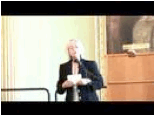
When I view the video clip, I can see and feel the energy and passion
with which I am speaking. I can feel the connection I am making with the people
in the room. I see myself living my values of what matters to me and what
drives me in my work as an Inclusion Officer with the responsibility of
implementing and developing the Bath and North East Somerset Inclusion Quality
Mark.
At this
Recognition Ceremony, I feel I am being recognized for the work that I do. At
the beginning of the clip, Nigel Harrisson, Inclusion Support Service manager,
is introducing me and acknowledging what I do when he says:
Chris is the driving force
behind the IQM and makes it happen.
I feel, also, that my commitment to the
Inclusion Quality Mark is being recognized by Gail Quinton, Divisional Director
of Learning and Inclusion, when she says:
It is Chris Jones
baby. She set it up, made it happen, organized it and worked hard.
As I feel that I am being recognized for
what I do, so I am recognizing the contribution that I am making to the
developing understandings of inclusion in the authority, and I am aware of the
educational influences in my own learning, in the learning of others and the
learning of social formations. At the validation meeting, it was stated:
I can see how the evidence, for example, the meaning of recognition is
emerging through the narratives, and towards the end…what you are saying…will
help us to understand the living presence of the meaning of inclusionality.
(Validation meeting, July 17, 2008)
As I continue to watch the video clip, I am reminded of the vibrancy
within the schools I mentored and assessed. I am reminded of the quality of
relationships within these schools. These schools are not here because they
ticked the right boxes. These schools are here because inclusion is at the core
of everything they do. The school community: pupils, teachers, teaching
assistants, school meals supervisory assistants (SMSAs), parents, administrative
staff and governors feel valued. They feel they have a voice in the school.
Inclusionality is living within these schools. The local newspaper
representative attends the event each year. A newspaper article and photograph about
the Recognition Ceremony 2007 can be found in Appendix H.
At the validation meeting, it was stated:
You've got these three
narratives…and for me, it's the difference in terms of the context, the
expression of inclusionality. So, you've got the pilot of the IQM, but if you
look at the role of mentors and assessors, that actually moves it into
extending the influence of inclusionality through the work of others, and then,
the evidence we are being given all the time is there,…the third one, the
Ceremony. Where that seems to be important is that you're bringing together
people to actually both recognise and celebrate their qualities of inclusion…so
I think you have provided us with evidence.
(Validation meeting, July 17,
2008)
In reflecting on this narrative, I now summarise my standards of
judgement that derive from the values I hold which have been demonstrated through
this narrative:
·
Influencing social formations, for example, the Recognition
Ceremony;
·
Recognising and valuing team work in preparing for
the Recognition Ceremony;
·
Influencing and sharing understandings of inclusion
and inclusionality within the authority with other educators in Children's
Service and schools;
·
Being able to recognize and acknowledge my
influence in driving forward inclusion and inclusionality within the authority;
·
Recognising and acknowledging the fact that I am
being recognized for the work I do by the Inclusion Support Manager and Divisional Director of
Learning and Inclusion;
·
Choosing the name, 'Recognition Ceremony' rather
than 'Awards Ceremony' and the significance of this as a reflection of my
values.
In this
chapter, I have I have described narratives which, I believe, demonstrate
inclusionality. The first three narratives (Appendices C, D and E) briefly described in this chapter, describe the inclusional
way I like to work with others, firstly, setting up and developing a course for
new SENCOs, secondly, running a creativity workshop with a colleague, and thirdly, running an emotionally literate workshop with a colleague.
In the next three narratives, I focused on my work in the implementation and
development of the Bath and North East Somerset Inclusion Quality Mark. With
reference to each narrative, I have described my standards of judgement which
have derived from my values which inform my practice.
CHAPTER 5 - MY EDUCATIONAL
NARRATIVE OF MY LEARNING
This is my
final narrative and it is an educational narrative of my learning as I reflect
on my inquiry and how I have inquired. Firstly, I shall reflect on the
narratives I describe as an Inclusion Officer in my previous chapter and in Appendices
C, D and E, and describe how my values have come to form standards of judgement
on which I judge my claim to educational knowledge. I then reflect on my
dissertation as a whole and the learning that has taken place as it has developed.
Finally, I highlight specific areas that have had a huge impact on my learning
as I have conducted my inquiry, firstly, the adoption of a living educational theory
methodology, secondly, the use of video in my inquiry and thirdly the
significance of Conversation Cafe.
Reflection on My Narratives as an
Inclusion Officer
Firstly, I
reflect on my narratives as an Inclusion Officer as described in my previous
chapter and Appendices C, D and E. In reflecting on these narratives, I am able
to see that I have an educational influence in my own learning, in the learning
of others and the learning of social formations. My reflections have been a
systematic form of action and reflection through which I clarify the meanings
of my energy –flowing values in the course of their emergence in my
practice. The new knowledge and understanding is in the relationally dynamic
standards of judgement I use in my work as an Inclusion Officer, for example,
in the awarding of the Bath and North East Somerset Inclusion Quality Mark.
I 'see' myself,
in reflecting on these narratives, living my values in my practice as an
Inclusion Officer. My values have been transformed into living standards of
judgement, whereby I am able to judge the validity of my claim to educational
knowledge. With reference to each narrative, I describe my standards of
judgement as expressing a
life-affirming energy with my inclusional values. I have collated these and
they can be found in Appendix I.
Reflection on the Development of My Dissertation
I would now
like to reflect on my dissertation as a whole and emphasise the learning that has
taken place as it has developed.
When I began my
dissertation, I wrote a series of stories and in developing my dissertation, I
put my stories together, discarding of some and including of others. I have selected
those stories that are of significance as to who I am, the impact that the experiences had on me, my
learning as a result of them and my reflection of them, and ones where I see myself
living my values. For example when I first wrote the stories of my childhood
memories in Chapter One, I had no intention, at the time, of including them in
my dissertation. I wrote these stories because I did not know where to start,
yet I wanted to write something of significance to me. I took my stories to
Conversation Cafe and people commented how powerful they were in their content.
I still had no intention of including them in my dissertation, but, at the
time, they certainly provided a way through for me and helped me focus on my
values and what mattered to me and why. It is only recently that I decided that
they had to be included; that this dissertation could not be without them.
These stories provide the essence of who I am and provide my earliest memories
of my feelings of injustice, unfairness, the abuse of power, humiliation and
discrimination. Trying to live values of justice, care and compassion have
driven me from a young age and has hugely impacted on how I have developed
personally and professionally as a teacher and an Inclusion Officer.
In selecting my
stories of my teaching career, I have chosen those whereby my learning has been
greatest, where I have seen myself living my values and as a result, making a
difference to the young people that I taught. At my first school, I saw how the
values of fairness, justice and equality of opportunity were being denied to
the pupils I taught, and worked towards addressing that, with success. The
ethnic diversity I experienced at that school has had a huge impact on me
personally, and ultimately in my role as an Inclusion Officer especially in the
working with schools towards the award of the authority's Inclusion Quality
Mark, whereby the promotion of diversity in these schools is now very much a
focus. Seeing the move from integration to inclusion in my second school, being
a part of the reorganisation and seeing the impact on the young people I taught
has been hugely significant in my learning and is yet again, a reflection of
the values I hold. Therefore, these stories had to be included.
The impact of
seeing Alan Rayner's paper dance of inclusionality lays the foundation of my
narratives as an Inclusion Officer. My narratives, as an Inclusion Officer,
demonstrate the inclusional way in which I like to work with others and how my
interactions and my relationship with people are crucial in how I have developed
personally and professionally. The idea of inclusionality encapsulates for me
my desire to work in a relationally dynamic way with others, living the values
of care, love, justice and democracy.
As I reflect on
my dissertation as a whole, each of its parts is significant in how I have
become and developed in my role as an Inclusion Officer. The thread running
through my dissertation are the values that I hold and drive me to do what I do
and the inclusional way I like to work with others.
At each stage
of my dissertation, my learning has been significant as I constantly reflect on
what I am doing and question the significance of each chapter to my role as an Inclusion
Officer. Throughout my inquiry, I presence myself to myself and I ask if I can
see myself living my values and demonstrating my inclusional way of being. As
my dissertation has developed, so I have developed in my role as an Inclusion
Officer as I have constantly reflected on my practice.
Reflection on the Adoption of a Living Theory
Methodology
Adopting a
living educational theory methodology has been hugely significant in my
learning as I have been able to inquire into my educational influences in my
own learning, in the learning of others and the learning of social formations.
It is through adopting this methodology that I have been able to reflect on my
practice and see if I am living my values as I have described throughout my
dissertation. My values have become living standards of judgement whereby I can
make my claim to knowledge. No other methodology would have allowed me to
undertake my inquiry in this way, and in Chapter Three, I draw on the
differences between this and the more traditional research processes. However,
at first, I did not find it easy to adopt the living theory methodology. I had
been used to working within the more traditional approaches. However, what
motivated me initially was the fact that I found this methodology motivating
and energizing. It was a methodology which focused on values and seeing our
values lived in our practice. I attended the BERA Conference at Warwick
University in 2006 and was inspired by the work of those who were using a
living educational theory methodology and wanted to learn more about it.
One of the experiences that transformed my responses from moving back into traditional forms of analytic framework was receiving and reflecting on responses from my colleagues. Sandra Harris, who supports me with administrative tasks and my line manager, Nigel Harrisson described the way they perceived me in my role as an Inclusion Officer, and their accounts (Appendices J an K ) were discussed at Conversation Cafe (21 April 2008). Sandra refers to my 'enthusiasm', my 'steely determination', being 'super sensitive' in my awareness of the other and that I make her feel secure in that she can trust me. She feels that between us there is a 'mutual respect' and that I have shown that I trust her. Nigel refers to my values, how they align with his and how he senses my values in everything I do:
Chris is passionate about justice and equality…On the receiving end
I can feel the passion and I know Chris is 100% committed to doing
what is right and including everybody. These are the values she lives
every day and demonstrates every day to all around her. This is
not a performance, this is Chris.
Throughout, he refers to me being, 'genuine,
warm and inclusive'. He refers to my trust and honesty. He concludes:
It is through that honesty that people come to trust Chris; to feel safe
in her hands.
These responses helped to stop me moving
back into traditional analytic frameworks that eliminated my embodied
expressions of the explanatory principles I used to explain my practice. Thus
has been the journey of my inquiry.
I was also helped to develop a living theory methodology with the help
of video.
Reflection on the Use of Video
The use of
video in my inquiry has had a significant impact on my learning. When I was
first introduced to the idea of using video in my inquiry, I was a little
apprehensive, because, like many, I did not feel comfortable about seeing
myself on video. However, I was open to the idea of being videoed, especially
if it could enhance my learning. Frequently, at Conversation Cafe, our
conversations were videoed and gradually I became used to seeing myself on the
screen. Moreso, I began to realize the value of using video as a form of
evidence on which I could judge my practice.
The use of
video, still images and text, and the interweaving of these has enabled me to
portray and perceive myself and my interactions with others in a way that text
alone could not transmit nor explain. Adler-Collins (2008), in response to Pip
Bruce Ferguson (2008) and Jack Whitehead (2008c) in Research Intelligence states:
Such scholars are seeing
that textual representations solely on printed pages does not adequately allow
us to communicate the lived, energy-flowing values we claim to hold in our
practices. There is a growing realization, excitement and frustration as new
technologies come on line that will allow us to explore the representation of
our knowing and knowledge in new mediums.
(Adler-Collins,
2008:17)
My learning has
been considerably enhanced through the use of video and has enabled me to see
myself and capture that moment in time exactly as it were without any bias that
could have occurred had it been purely reliant on my reflection. The use of
video, I believe, has enhanced the truth, sincerity and validity of my research
and my claim to know. Laidlaw states:
In such complex work we
need different ways of representing what we know and video has become a crucial
avenue to the realization of our endeavours.
(Laidlaw, 2008:16)
However, it is
not only about capturing that moment in time. What I have learnt is that significant
learning has taken place as I reflect on what I am seeing as I watch the video
clips and analyse my practice.
Laidlaw further states:
It isn't simply that I
need to work with video and multimedia forms of representation to express more
clearly what is being done, it is that watching the video changes the nature of
knowledge itself and allows its development.
(Laidlaw,
2008:17)
The use of
video has enabled me to presence myself to myself whereby I can make judgements
about my inclusional way of being. As I look at the video clips, I am able to reflect
on what I am seeing and I am learning as a result of my reflection.
Reflection on Conversation Cafe
Our weekly
discussions at Conversation Cafe have been invaluable in the development of my
inquiry and in my own learning. I would go as far as to say that I do not think
my inquiry would have developed in quite the same way without the support of
this group. My colleagues have acted as critical friends, many times meeting
outside Conversation Cafe and sending emails to each other; constantly
questioning my accounts and helping me to clarify issues as they have arisen
throughout my inquiry. The group has also acted as a validation group to
discuss the validity of my inquiry, using Habermas' criteria of social
validity.
Taking my work
to Conversation Cafe has been a huge shift for me in my learning. Previously, I
had been used to working independently and sharing my work with my supervisor
only. To present my work to be critically evaluated by colleagues made me feel
very vulnerable at first. However, I began to realise that in sharing my work,
it helped me reflect further on what I was doing and helped me through times
when I was unsure as to how to progress. Colleagues would bring their own
inquiries to Conversation Cafe and discussing and reflecting on their inquiries
has frequently shifted my learning and understandings further. At times when I
have felt demoralized, the group has encouraged me, written their reflections
on my practice and enthused me with their perceptions.
Although my
dissertation may be at a close, my learning will continue as I further inquire
into my question, 'How can I improve my practice as an Inclusion Officer?' at
our weekly gatherings at Conversation Cafe.
In this
chapter, I have described my educational narrative of my learning. I have
briefly reflected on my narratives as an Inclusion Officer, I have reflected on
my learning throughout this dissertation, and focused specifically on the
impact on my learning through adopting a living theory methodology, the use of
video and the significance of Conversation Cafe.
CHAPTER 6 - CONCLUSION
In this dissertation, I have described my
journey as an Inclusion Officer. I have made known my personal knowledge and
personal experience working in a Children's Service. I believe this to be
unique, as throughout my research, I have not found any other account of the
work of an Inclusion Officer working in a Children's Service. In relating my journey and making it
public, I believe that I have made a contribution to educational knowledge. I
have explained my evolving understandings of inclusion and have inquired and
explored about the nature of inclusionality.
I have clearly expressed my values
describing the impact of earlier memories and also my early experiences of
teaching and how these have impacted on my development as an Inclusion Officer.
In this dissertation, I am claiming to know
my educational influence of my own learning, in the learning of others and the
learning of social formations. In making my claim to know, I adopted a living educational
theory methodology and presented data and evidence as I inquired into my
question, 'How can I improve my practice as an Inclusion Officer working in a
Children's Service?'
At this point, it may be pertinent to state
that it is always possible to present alternative explanations of data by
drawing on conceptual frameworks from a range of disciplines. For example, my
data could have been analysed through a social lens. In the light of this, I
would like to bring attention to Schon's points to say that data on successful
supervisions of living theory dissertations and theses could be used in an
analysis of the 'battle of snails' that Schon refers to:
If we intend to pursue the 'new forms of scholarship' that Ernest
Boyer presents in his Scholarship Reconsidered, we cannot avoid
questions of epistemology, since the new forms of scholarship he
describes, challenge the epistemology built into the modern
research university.
(Schon, 1995: 27)
Hence, introducing the new scholarship into institutions of higher
education means becoming involved in an epistemological battle.
It is a battle of snails, proceeding so slowly that you have to
look very carefully in order to see it going on. But it is happening
nonetheless.
(Schon, 1995: 32)
I have used video to presence myself to
myself. I believe that the video evidence has helped me to 'see' my development
as an Inclusion Officer and has helped me to inquire, examine and develop my
ontological way of being as I strive to work inclusionally with others in my
practice. In generating educational knowledge about inclusionality, I have
shown and demonstrated living standards of judgement which both characterise
inclusionality and I have used them to evaluate the validity of my claim to
educational knowledge made from within an inclusional perspective.
It is without a doubt that my practice as an
Inclusion Officer working in a Children's Service has improved. Firstly, I see
myself, as an Inclusion Officer, working towards and living my values, and
recognise the impact that this has on my practice in that they are the
foundation of what I do. I believe that others see me living my values and come
to trust my sincerity. Secondly, I recognise the inclusional way in which I
like to work with others and the significance of my interactions and
relationships with others. This has a huge impact on my practice and I believe
that as a result of this way of working, the outcomes are beneficial to myself
and others. Thirdly, I have learnt to take risks, or rather, I am now more
confident in my ability to take risks, and this has opened up possibilities for
growth and development for myself and others and will continue to do so.
Fourthly, I have developed, and I am now more able to articulate, a better
understanding of inclusion and the link between inclusion and inclusionality which
has a huge impact in what we look for in the awarding of the Bath and North
East Somerset Inclusion Quality Mark to schools. Next, I feel that I have made
a contribution to the promotion of diversity within schools working towards and
achieving the award and there is evidence of this when I visit these schools. Finally,
I have become more confident, as the Bath and North East Somerset Inclusion
Quality Mark within the authority grows, and feedback from schools describe
their development throughout the process. Now, there are twenty schools within
the authority which have achieved the award, three schools are about to be
assessed and seven schools wish to be a part of the next cohort.
This concludes my dissertation, but my
practice as an Inclusion Officer will continue to develop, grow and improve as
I continue to reflect, question and evaluate what I do as I constantly seek to
live my values in my practice.
REFERENCES
Adler-Collins, J. (2008) Creating new forms of living educational
theories through collaborative educational research from Eastern and Western contexts:
A response to Jack Whitehead. Research
Intelligence 104, 17-18.
Ainscow, M., Booth, T. and Dyson, A. with Farrell, P., Frankham, J.,
Gallanaugh, F., Howes, A., Smith, R. (2006) Improving Schools, Developing
Inclusion. Oxon: Routledge.
Bath and North East Somerset Local Authority. (2006) Children and Young People's Plan 2006-2009. Bath:
Bath and North East Somerset Local Authority.
Bell, J. (2003) Doing your
Research Project: A Guide for First- Time Researchers in Education and Social
Sciences (third edition). Milton Keynes: Open University Press.
BERA (2004) Revised Ethical
Guidelines for Educational Research.
Birmingham City Council. (2002) Standards
for Inclusion: Success for Everyone. Birmingham: Birmingham City Council.
Booth, T. (2003) Viewing inclusion from a distance. In Nind, M., Rix, J.,
Sheehy, K. and Simmons, K. (eds) Inclusive Education: Diverse Perspectives. London:
David Fulton Publishers in association with The Open University.
Booth, T., Ainscow, M., Black-Hawkins., Vaughan, M. and Shaw, L. (2000) The
Index for inclusion: developing learning and participation in schools.
Bristol: Centre for Studies on Inclusive Education.
Bristol City Council. (2003) Bristol
Inclusion Standard: Good practice guidance for Schools. Bristol: Bristol
City Council.
Bullock, Lord (Chairman) (1975) A Language for Life. London:
HMSO.
Carr, W. and Kemmis, S. (1986) Becoming Critical: Education,
Knowledge and Action Research. London: Falmer Press.
Clandinin, D.J. (ed) (2007) Handbook
of Narrative Inquiry: Mapping a Methodology. Thousand Oaks, New Delhi, New
York: Sage
Clandinin, D.J. and Connelly, F.M. (2000) Narrative Inquiry:
Experience and Story in Qualitative Research. San Francisco, Jossey- Bass.
Coles, C.J. and Hancock, R. M. (2002) The Inclusion Quality Mark. Cheshire: Public Sector Matters.
Connelly, F.M. and Clandidin, D.J (1988) Teachers as curriculum planners: narratives of experience. New
York: Teachers College Press.
Connelly,
F.M. and Clandinin, D. J. (eds.) (1990) Stories of experience and narrative
inquiry. Educational Researcher, 19 (5), 2-14.
Connelly, F.M. and Clandinin, D.J. (1999) Shaping a Professional Identity: Stories of Educational Practice. Canada:
The Althouse Press.
Corbett, J. (2001) Supporting Inclusive Education. A Connective
Pedagogy. London: Routledge Falmer.
Cresswell, J.W. (2007) Qualitative
Inquiry & Research Design: Choosing Among Five Approaches. California,
London, New Delhi: Sage
Dadds, M. Hart, S. (2001) Doing
Practitioner Research Differently.
London: Routledge Falmer.
Delong, J. (2002) How Can I
Improve My Practice as a Superintendent of Schools and Create My Own Living
Educational Theory? PhD thesis. University of Bath. Retrieved 9 March 2008
from http://www.actionresearch.net/delong.shtml
Dewey, J. (1938) Experience and
education. New York: Collier Books.
DfEE. (1997) Excellence For All
Children: Meeting Special
Educational Needs. London: DfEE.
DfEE. (1998) Meeting Special
Educational Needs: A programme of action. London: DfEE.
DfEE. (1999) The National Curriculum: Handbook for primary teachers
in England key stages 1 and 2. London: DfEE and QCA.
DfES. (2001a) Inclusive Schooling.
London: DfES.
DfES. (2001b) Special Educational
Needs Code of Practice. London: DfES.
DfES. (2003) Every Child Matters. London:
DfES.
DfES. (2004) Removing Barriers to
Achievement:The Government's Strategy for SEN. London: DfES.
DfES. (2005) A National
Conversation about Personalised Learning. London: DfES
Eisner, E. (1988) The Primacy of Experience and the Politics of Method. Educational Researcher, 17(5), 15-20.
Eisner, E. (1993) Forms of Understanding and the Future of Educational
Research. Educational Researcher, 22(7), 5-11.
Evans, L. (2007) Inclusion. London: Routledge.
Farren, M. (2005) How Can I Create
a Pedagogy of the UniqueThrough A Web of Betweenness? PhD thesis. University of Bath.
Retrieved 3 March 2008 from
http://www.actionresearch.net/farren.shtml
Farren, M. & Whitehead, J. (2006) Educational Influences in Learning
with Visual Narratives, in Childs, M., & Riley, K. (2006) Developing
Innovative Video Resources For Students Everywhere. Glasgow:
Glasgow Calendonian University.
Ferguson, P. B. (2008) Increasing Inclusion in Educational Research:
Reflections from New Zealand. Research
Intelligence 102, 24-25
Furlong, J. & Oancea, A. (2005) Assessing Quality in Applied and
Practice-Based Educational Research. A Framework for Discussion. Retrieved 15
January 2008 from
http://www.education.bham.ac.uk/research/seminars1/esrc_4/documents/Furlong_Oancea.pdf
Golby, M. and Gulliver, J. (1979) Whose remedies, whose ills? Journal
of Curriculum Studies, 11.
Habermas, J. (1976) Communication
and the Evolution of Society. London: Heinmann
Hargreaves, D. (1984) Improving Secondary Schools. London: ILEA
Hart, S. (2003) Learning without limits, in Nind, M., Sheehy, K.,
Simmons, K. (eds) (2003) Inclusive Education: Learners and Learning
Contexts. London: David Fulton Publishers in association with The Open
University.
Hartog, M. (2004) A Self Study of
A Higher Education Tutor: How Can I Improve My Practice? PhD thesis.
University of Bath. Retrieved 19 October 2008 from
http://people.bath.ac.uk/edsajw/hartog.shtml
Hayward, A. (2006) Making
Inclusion Happen: a practical guide. London: Sage Publications
Hitchcock, G. and Hughes, D. (1995) Researcher and the Teacher: A
Qualitative Introduction to School-based Research (second edition). London
and New York: Routledge.
Jones, C. (1988) An Assessment of the Provision for Pupils with
Special Needs at Brune Park School: An Evaluation of the Whole School Approach.
Dissertation for Diploma in Professional studies in Education (Special
Education). King Alfred's College, Winchester.
Jones, C. and Huxtable, M. (2006) How
can we support educators to develop skills and understandings inclusionally. Paper
presented at the British Educational Research Association Conference,
University of Warwick on 4th September, 2006.
Kennedy, V. (2005) Why is
inclusionality so important to me? Ticking the Inclusionality Box. M.A.
Assignment. University of Bath. Retrieved October 19 2007 from http://www.jackwhitehead.com/monday/vkmaee1.pdf
Laidlaw, M. (2008) Increasing Inclusion in Educational Research: A
Response to Pip Bruce Ferguson and Jack Whitehead. Research Intelligence,
104, 16-17
Lewin, K. (1946) 'Action research and minority problems', Journal of
Social Issues, 2, 34-6.
Marks, S. (1989) Not Either An Experimental Doll. Pietermartizburg:
University of Natal Press.
McAdams, D.P. (1985) Power,
intimacy and life story. Homewood, IL: Dorsey.
McNiff, J. (2002) Action research for professional development. Concise
advice for new action researchers. Retrieved 4 May 2008 from
http://jeanmcniff.com/booklet1.html
Mc Niff, J. (2006) How do I contribute to the transformation of
epistemological hegemonies for sustainable social evolution. Paper
presented at the symposium, How do we explain the significance of our
self-study enquiries for the future of educational research? at the British
Educational Research Association Conference, University of Warwick on 8th
September 2006.
McNiff, J. (2007) My Story Is My Living Educational Theory, in
Clandinin, J. (2007) Handbook of Narrative Inquiry: Mapping a Methodology.
Thousand Oaks, New Delhi, New York: Sage.
McNiff, J. and Whitehead, J. (2005) Action
Research for Teachers. A practical guide. London: David Fulton.
Newman, J.M. (2000) Action Research: A Brief Overview, in Forum: Qualitative Social Research, 1(1), 1-4. Retrieved 30 September, 2007
from http://www.qualitative-research.net/fqs-texte/1-00/1-00newman-e.htm
Nind, M., Sheehy, K., Simmons, K. (eds) (2003) Inclusive Education:
Learners and Learning Contexts. London: David Fulton Publishers in
association with The Open University.
O' Donohue, J. (2003) Divine
Beauty: The Invisible Embrace. London: Bantam
Ofsted (2000) Evaluating educational inclusion: Guidance for
inspectors. London: Ofsted.
Powell, R.A. and Single, H.M. (1996) 'Focus Groups', International Journal of Quality in Health
Care 8 (5), 499-504
Rayner, A. (2003) Natural Togetherness – Reason to Love Our Enemy.
Retrieved 28 May 2007 from http://people.bath.ac.uk/bssadmr/inclusionality/
Rayner, A. (2004) Inclusionality: The Science, Art and Spirituality of
Place, Space and Evolution. Retrieved 28 May 2007 from http://people.bath.ac.uk/bssadmr/inclusionality/
Rayner, A. (2006a) Essays and Talks about Inclusionality by Alan Rayner.
Retrieved 24 May 2007 from http://people.bath.ac.uk/bssadmr/inclusionality/
Rayner, A. (2006b) Ten questions and answers about my understanding of
'inclusionality' – a way of seeing beyond human ideological conflict to
the restoration of our natural neighbourhood. Retrieved 29 May 2007 from
http://people.bath.ac.uk/bssadmr/inclusionality/
Rieser, R. (2003) The struggle for inclusion. In Nind, M., Rix, J.,
Sheehy, K. and Simmons, K. (eds) Inclusive
Education: Diverse Perspectives. London: David Fulton Publishers in
association with The Open University.
Rossiter, M. (1999) A Narrative Approach to Development: Implications
for Adult Education, in Adult Education
Quarterly, 50, 56. New York: Sage
Rustemier, S. (2002) Social and Educational Justice: the human rights
framework for inclusion. Bristol: Centre for Studies in Inclusive
Education.
Schon, D. (1983) The Reflective Practitioner: How Professionals Think
in Action. New York: Basic Books.
Schon, D. (1995) The New Scholarship Requires a New Epistemology. Change, Nov/ Dec. 27 (6), 27-34
Snow, C.E. (2001) Knowing What We Know: Children, Teachers, Researchers.
Presidential Address to AERA, 2001, in Seattle, in Educational Researcher,
30 (7), 3-9.
Special Educational Needs and Disability Act 2001 (HMSO)
Spiro, J. (2008) How I have arrived at a notion of knowledge
transformation, through understanding the story of myself as creative writer,
creative educator, creative manager, and educational researcher? PhD
thesis. University of Bath. Retrieved 1 July 2008 from http://people.bath.ac.uk/edsajw/janespirophd.shtml
Sullivan, B. (2006) A living theory of a practice of social justice:
realizing the right of traveller children to educational equality. PhD
thesis. University of Limerick. Retrieved 3 June 2008 from http://www.jeanmcniff.com/bernieabstract.html
Teacher Training Agency (1998) National Standards for Special Needs
Coordinators. London: TTA.
The Education Act 1996 (HMSO).
The Children Act 2004 (HMSO).
The Education and Inspections Act 2006 (HMSO).
Topping, K. and Maloney, S. (2005) The Routledge Falmer Reader in
Inclusive Education. London: Routledge Falmer.
UNESCO. (1994) The Salamanca
Statement and Framework for Action on Special Educational Needs. Paris:
UNESCO.
UNESCO. (1998) All human beings…A
manual for human rights education. Paris: UNESCO.
Vasilyuk, F. (1991) The Psychology of Experiencing: the Resolution of
Life's Critical Situations. Hemel Hempstead: Harvester Wheatsheaf.
Warnock, H.M. (1978) Special Education Needs Report of the Committee
of Enquiry into the Education of Handicapped Children and Young People. London: HMSO.
Whitehead, J. (1989) 'Creating a living educational theory from
questions of the kind, 'How do I improve my practice?', Cambridge Journal of
Education, 19(1), 41-52.
Whitehead, J. (2003) 'Creating our living educational theories in
teaching and learning to care: using multi- media to communicate the meanings
and influence of our embodied educational values', Teaching Today for
Tomorrow, 19, 17-20.
Whitehead, J. (2005) Living Educational Theory and Standards of
Judgement: A contribution to the debate assessing the quality of applied and
practice-based educational research. Retrieved 15 January 2008 from http://www.jackwhitehead.com/monday/arrkey05dr1.htm
Whitehead, J. (2006) Have we created a new educational epistemology in
our living educational theories as practitioner-researchers? A Keynote
Presentation to the Practitioner Researcher Conference on Living Theory or
Empty Rhetoric at St. Mary's College on 13 July 2006. Retrieved 5 December 2007
from http://jackwhitehead.com/jack/jwkeynote130706.htm
Whitehead, J. (2008a) How Do I Influence the Generation Of Living
Educational Theories For Personal and Social Accountability in Improving
Practice? Using A Living Theory Methodology In Improving Educational Practice.
Retrieved July 5 2008 from http://www.jackwhitehead.com/jack/jwLTM080508.pdf
Whitehead, J. (2008b) Justifying the use of a living theory methodology
in the creation of your living educational theory (Draft). Retrieved November
30 2008 from http://www.jackwhitehead.com/jack/Cresswellqualitativemethods.pdf
Whitehead, J. (2008c) Increasing inclusion in educational research: A
response to Pip Bruce Ferguson. Research
Intelligence, 103, 16-17
Whitehead, J. & McNiff, J. (2006) Action Research: Living Theory.
London: Sage.
Whitty, G. (2006) Education(al) research and education policy making: is
conflict inevitable? Presidential Address to the British Educational Research
Association, University of Glamorgan, 17 September 2005. British
Educational Research Journal 32 (2),
159-176
APPENDICES
Appendix A - Summary
of Work of Inclusion Officer, July, 2004
INCLUSION OFFICER: Chris Jones
Date of commencement: February 23rd 2004
To support the LEA's Inclusion agenda,
working creatively and collaboratively in partnership with schools, LEA support
teams, LEA officers and agencies such as the Health Service and Social services
to minimise barriers to learning and participation in educational settings and
support diversity in order to promote a culture of Inclusion in all educational
settings.
February 23rd – 16th
July 2004
·
Visiting early years settings, schools and
attending SENCO cluster meetings to gather information on effective inclusive
practice, what needs developing and what is required from the LEA. Findings to
be presented to SIG in June.
·
Working in partnership with the Health Service by
attending team meetings (Physiotherapists, Occupational Therapists, School
Nurses, CAMHS, Speech and Language Therapists) and investigating ways of
working together.
·
Working in partnership with the head teachers of
Summerfield and the RUH Special Schools to investigate ways of working with mainstream
schools in the light of the development of the new special school.
·
Working in partnership with the LEA support
services to discuss actions that can be put in place in response to what
schools feel is required from the LEA.
·
Working in partnership with BSUC: Associate tutor
on the module, 'Inclusivity and SEN'.
·
Investigating the Inclusion Quality Mark/Inclusion
Standards for implementation in BANES.
·
Producing a 'Name and Acclaim' bulletin on Good
Practice regarding Inclusion.
End of Summer Term 2004
– March 2005
·
To continue to develop partnerships already in
place and work towards implementing actions already investigated and discussed.
·
To further promote cross service working within the
LEA in order to support Inclusion.
·
To project manage the LEA's Inclusion Plan to
ensure that actions agreed in it are on track and to make regular progress
reports to the Inclusion Manager.
·
To continue to lead on the implementation of a
BANES Inclusion Standard/Quality Mark.
·
To advise and support early years settings and schools to achieve
greater inclusive practice by working with staff to develop an Inclusion Policy
which removes barriers to learning and participation and to provide training
where necessary.
Appendix B - Research
Brief and Consent Form
Research Brief
How Do I Improve My Practice as
an Inclusion Officer working in a Children's Service?
This research is being undertaken by Christine Jones, Senior Inclusion
Officer, working with the Children's Service in Bath and North East Somerset
Local Authority
Aims
This research will focus on the work I do as an Inclusion Officer
working in the Local Authority, and how I can improve my practice. In this
research I will explore, inquire and focus on generating educational knowledge
about the nature of inclusionality (Rayner, 2006) which may be described as a
relationally dynamic and responsive awareness of others which flows with a
desire to live such values as care, compassion, love and justice more fully in
one's own practice. I intend to focus on the work I do in the running of
courses, workshops and the implementation and development of the Bath and North
East Somerset Inclusion Quality Mark. It will involve working with other
educators in the Children's Service and also schools. Data will be obtained
through a variety of means including video and written sources.
Research Ethics
·
Participants must give consent to participate in the research project.
·
Participants may withdraw at any time.
·
Participants may have the opportunity to ask questions about the
research.
·
Research will be conducted in accordance with the British Educational
Research Association Guidelines.
·
Names of individuals and schools shall be anonymous unless permission is
given otherwise.
·
The research report and any associated writings are the property and
copyright of the researcher. The report will be subject to external
publication.
·
Participants who are video recorded will be informed if any video clips
are to be used and permission will be sought to use the clip. If a participant decides
that s/he does not wish the video clip to be used then this decision will be
respected by the researcher.
·
This research may be published in a variety of forms.
Consent
I confirm that I have agreed to participate in the research project.
I have been briefed on what this involves and I agree that the findings
be used as described above.
I do /do not wish my name/name of my school to be used in this research.
Please tick as appropriate:
I have agreed to be video recorded.
I have agreed that video clip/s of me be used in this research.
I have agreed that still image/s of me be used in this research.
I have agreed that my emails are used in this research.
I have agreed that my written accounts are used in this research.
I have agreed that video clips of my school are used in this research.
I have agreed that extracts from a report on my school be used in this
research.
.
Signed…………………………….. Date…………………….
Name in Print……………………………..
Name of School (if appropriate)……………………………………………………
Please return this form to:
Christine Jones
Senior Inclusion Officer
Inclusion Support Service
Children's Services
Bath and North East Somerset
Tel 01225 394492
E-mail: Christine_jones@bathnes.gov.uk
Appendix C - Full
Narrative of 'Development of a Course
for New Special Educational Needs Coordinators (SENCOs)' including still image
and video clip
Before becoming an Inclusion Officer, I was
a SENCO at a Primary School in the authority. I had been a SENCO for six years
and as a result knew many SENCOs. On becoming an Inclusion Officer and to keep
contact with those already established, I attended the various SENCO cluster
groups in the area. In fact, there was almost a need within me to do this. I
still felt very much a SENCO and I felt the need to be with them and to
continue that relationship with them that I had always enjoyed. This was very
important to me. In the following video clip, I
describe the connection I felt with SENCOs
Plate 8: Chris
speaking to colleagues
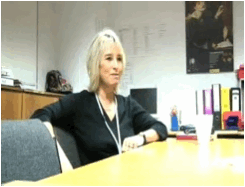
As I view the video clip, I feel that I am
expressing very clearly how highly I value working with SENCOs and how much I
enjoy that buzz, connection and flow of interaction; that feeling of
inclusionality when we work together.
On attending the SENCO cluster groups, new
SENCOs would approach me explaining that they were new in post and were very
unsure as to many aspects of the
job, for example, putting in requests for statutory assessments, when to put a
pupil on school action and when to put a pupil on school action plus etc. I
knew that there was SENCO accreditation training (one year duration) which was
a local authority initiative set up in collaboration with Bath Spa University.
I had attended this course myself and had gained SENCO accreditation, and
followed on by becoming a mentor on the course. It was a course based on the
development of the skills and knowledge of a SENCO as according to National Standards for Special Educational
Needs Coordinators (TTA, 1998). A course had also been run for new SENCOs
focusing on aspects of the Special Educational
Needs Code of Practice (DfES, 2001b). This had followed on from the SENCO
accreditation course but had now finished. I knew what it had been like to be a
new SENCO. It had been daunting, with many sleepless nights, even though I had
been in special needs education my entire career. What it was like for new
SENCOs who had had very little experience of special needs and were full- time
class teachers, I could not imagine. There were many courses being run for
SENCOs by the learning support and behaviour support teams regarding learning
and behaviour, but there was nothing about the day to day job of a SENCO. I
decided to set up a course to meet the needs of new SENCOs to enable them to
have training on the 'day to day' job.
Initially, I wondered whether to put on a
two day intensive course at the beginning of the year or to spread it out over
the year. I decided on the latter, as I felt that this would give the SENCOs support
over a year whereby they could discuss issues as they arose with each other and
with me. I decided to run five sessions in the first year of the course, 2004
– 2005, as the academic year had already started and the first session
would not be until November. In subsequent years there would be six sessions
beginning in September. There would be one session every half term, each
session being two hours in duration. Each session would focus on an aspect of
the work of a SENCO. Rather than me lead on all the sessions, I decided to ask
team leaders in the Inclusion Support Service and my former head teacher to
lead on the sessions. This I felt, would add another dimension to the course as
it would give SENCOs the opportunity to meet with the team leaders in the
Inclusion Support Service. The team leaders were more than willing to support
the programme and have done so each subsequent year. Added to this, a senior
lecturer at Bath Spa University with whom I had worked on previous courses
offered the use of rooms at the university to run the course and also accredit
SENCOs for work done on the course should SENCOs wish to work towards a further
qualification. A handbook was developed to address this. I decided that the
course would also benefit SENCOs who had been in post for a few years but
needed a refresher. A flyer was sent out to SENCOs and fifteen SENCOs were
enrolled.
The fourth year of the course has been completed recently.
The same formula has been used each year with slight changes to the programme as
national and local initiatives have been introduced, and also through
suggestions being made by SENCOs attending the course.
My concern had been the fact that new SENCOs
were working in a job which required the furthering of their skills and
knowledge and were frustrated that there was no training in place, at the time,
to address this. I addressed my concern by putting on a course to meet the
needs of new SENCOs. Since it has been set up, I have reviewed and evaluated
the course and have made changes accordingly. The development of this course
has led to a better understanding of myself and how I like to work. It
demonstrates to me the inclusional way in which I like to work with others. It
is working in this way that gives me great satisfaction:
The course continues to be successful, and SENCOs enjoy
and benefit from the course. The course exposes them to
team leaders of the Inclusion Support Service and also
personnel at Bath Spa (University). I am enjoying leading
on the course and enjoying my interactions with SENCOs,
team leaders and Mim (Senior Lecturer) at Bath Spa (University).
It works so well.
(Reflective Journal, 8 March, 2007)
My learning has been significant. In setting
up this course, and in reflecting on this, I am aware that there are layers of
relationships involved which, I believe, have been fundamental to the success
of the course. It is not only my connection and inclusional ways of working
with SENCOs but also my inclusional way of working with the team leaders of the
Inclusion Support Service. The nature of this course is, because of their
involvement. The team leaders have never refused to run a session even though
their workload is heavy, and they have never asked for payment. In fact, I
believe that their involvement has added further to the quality of our relationships
and how we work together. Another
layer of relationships involved is that between the team leaders and the
SENCOs. SENCOS have stated how valuable they have found this:
I feel much more confident about procedures and expectations of
the LEA. My role feels more clearly defined. I have also established
a network of professionals I can now approach for further advice. I
feel more confident now about disseminating information to staff
and parents/carers.
(SENCO on Course, 2007-2008)
A further layer of relationships
interconnecting with the others is that between the SENCOs themselves, and I am
reminded that the reason I wanted to put the course on for over the year was
that it would give SENCOs the support from other SENCOs and opportunities to
discuss issues together. The comment below from a SENCO in responding to the
question, 'Which aspects (of the course) were particularly useful?' draws
together the value she saw through meeting with other SENCOs and also people
from the external services:
Opportunity to receive targeted information and input, and discuss
our understandings in a small, supportive group. It's been good to
meet up with other SENCOs, and to meet with the faces behind
the names of the people with responsibility for facilitating provision.
(SENCO on Course, 2005-2006)
Further connections in relationships are
between myself and personnel at Bath Spa University, and those at Bath Spa
University with SENCOs and team leaders of the Inclusion Support Service. To
recognise this mesh of relationships and the interplay between each has been
fundamental in my learning as to the success of the course.
I believe that the course has helped the
learning of new SENCOs and has equipped them to do their jobs better. One SENCO
commented:
I have been confused especially with the issue of whether to go
for a statutory assessment or not since the 2005 change….This
confusion was one of the main reasons for attending this course
…..after having a personal discussion with Christine Jones, I
feel my concern has now been clarified.
(SENCO on Course, 2007-2008)
Another commented on the impact of the
course in relation to their professional needs:
Impact has been large – going from very little to having a greater
understanding of SEN issues and a clearer picture of the SENCO
role within that. The key aspects have really focused the learning to
be beneficial to my role and more importantly the learners (children!)
(SENCO on Course, 2007-2008)
And:
I started the role of SENCO in September '07 without any prior
experience of the role. The course has enabled me to gain good
grounding in six key aspects of the role of SENCO. It has given me
the confidence to create a
Provision Map to support a school of
about 500 pupils.
(SENCO on Course, 2007-2008)
Finally:
Thank you for the refresher course which I found very useful
and informative. It certainly made me feel a lot more confident
in my new role. I am sure that the input I received helped us as a
school to receive such a positive
report from Ofsted in terms of
SEN provision…thanks again for
all the advice and for being so
warm, approachable and welcoming. (SENCO
on Course, 2004-2005)
The success of the course each year motivates me to continue to run the course. Comments in the evaluations, as above, demonstrate to me that SENCOs are learning and benefiting from the course, and ultimately, this is benefiting the children. My learning has been significant in seeing the interplay and mesh of relationships that have highly contributed to the success of the course. It is this interplay and mesh of relationships, and moreso, the awareness of this, that has contributed to the success of other initiatives which I have implemented since being an Inclusion Officer in the authority, including the implementation and development of the Bath and North East Somerset Inclusion Quality Mark.
Appendix D - Full
Narrative of 'Creativity Workshop,
SENCO Forum, Bath and North East Somerset, June 2006' including still images
and video clips
In my account of 'Setting up a Course for
New Special Educational Needs Coordinators (SENCOs)' (Appendix C), I gave a
clear description of what I did, what my concerns had been, how I had addressed
them and the impact on my learning and the learning of others. However, as my critical friends at
Conversation Cafe stated, the account, in the way it was written, was somewhat
dull and needed to be enlivened. It was felt that it did not draw on and bring
out the 'me' in my relationship with others; how I relate to people and my
interactions with them. As a critical friend stated:
The account needs to be brought alive to reflect the energy
with which you work and to demonstrate your inclusional
way of being.
(Conversation Cafe, 8 May, 2008)
To demonstrate my inclusional way of working
with others, I would like to focus on a creativity workshop which was developed
and led by a colleague, Marie Huxtable, Senior Educational Psychologist, and
me. A full account of the creativity workshop has already been described in a
paper (Jones and Huxtable, 2006) which Marie and I presented at the BERA
Conference at Warwick University, 2006
I would like
to focus on video clips of Marie and me at this workshop. Jack Whitehead
attended our second workshop and videoed the session in the afternoon.
Following the workshop, he brought a clip to Conversation Cafe (15 June, 2006) and the group felt that they could see the
energy with which I worked. They suggested that I may get to a better
understanding of myself living my values of inclusionality if I watched the
video and responded to what I was seeing. As a result I wrote an account of
what I could see. Jack, in preparing a keynote (Whitehead, 2006), engaged with
my account and selected appropriate video clips and images from the hour
session. I present my account here with the selected video clips:
“I am smiling as I watch the video of our Creativity Workshop and I
am feeling the joy and pleasure in seeing inclusionality being demonstrated
naturally and spontaneously in, between and with my friend and colleague,
Marie, and other educators who are participants in the workshop. I am looking
at Marie as she is inviting the group to respond to her questioning with her
arms open, her eyes scanning the room and including all.”
Plate 9: Marie and Chris, Creativity Workshop, 2006
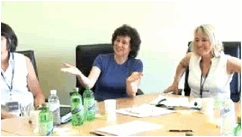
“I feel the joy and pleasure in looking at Marie and myself, sitting adjacently and leaning forward and smiling as we engage with the participants in discussing creativity, being creative and creating that moment together and with others”
“We move outside the room and as I listen to what I am saying, I feel the flow of energy that I felt at the time and as I always feel when I am working with colleagues, every interaction unique and co-creative. I am listening to the expressive, 'ooh', and the intermittent laughter as the egg is passed around, all apprehensive should the egg fall, all separate, yet one as we share the activity in that moment in time. Silence follows laughter and laughter follows silence; those bursts of energy cutting through the atmosphere of apprehension. There are no barriers here between us; there is no vacuum dividing us; we are flowing as one and as the first task is complete, we clap spontaneously together.”
“I am still smiling as I watch the video as we move back into the room. The conversation, the questions and answers, the smiles and the laughter; Marie and I sitting adjacently, moving forward in response to comments, hands moving, arms outstretched, openly invitational.”
Plate 10: Chris and Marie, Creativity Workshop, 2006
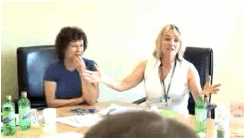
“Can anyone see what I see? Does anyone feel as I feel? As I watch the flow of interaction between one and the other, I am reminded of Rayner's Paper Dance of Inclusionality (CD 2.rayner.mov) and O' Donohue's 'web of betweenness' (2003). I am looking at inclusionality in action of which I am a part and I am seeing the flow of life- affirming energy between Marie, the group and me, and as I watch, I am feeling the joy of what for me gives life meaning – the flow of interaction between one and the other and the pleasure of that co-dynamic relationship. I am reminded of these feelings of joy when I was a teacher interacting with the class: I am learning from them; they are learning from me; we are all learning together in a co-creational relationship which could not happen without one or the other within that moment in time.
I value who I am and what I try to be; I value others for who they
are and what they try to be; I value what we are between us and what we try to
be. It is through my relationship with others and the generative flow and
pleasure of our interaction that I grow and live a life that has meaning for
me.”
Plate 11: Chris and Marie,
Creativity Workshop, 2006
I have not read this account or looked at
these video clips for sometime but as I do, I feel the integrity and
genuineness of what I have written and in my interactions in the video clips.
It really does connect with the person I feel I am and what I want to be. It is
in looking at these video clips that I am affirmed and energized in what
matters to me and what I value. It is the pleasure of being with others and
enjoying each other for who and what we are, interacting, reacting, having fun
and learning with and from each other; learning together and to be open to all possibilities.
This workshop was a big step for Marie and me. We did not
want to tell people what creativity was. We wanted people's understandings to
develop through creating a space for creativity to evolve in the very being of
how we planned the workshop. It was a risk but it was a risk that worked. Marie
and I had such fun in planning it. I have learnt the importance of taking risks
in my job; of treading that untrodden path (Spiro, 2008) and trusting in
colleagues to share that journey with me. I have learnt about the emotions of
taking risks; the anxiety, the excitement, the feeling of exhilaration. But it
is not only the feeling of these emotions; it is the sharing of these emotions
together. In one of the activities, the group had to pass an egg to each other
and was told that it was uncooked. Afterwards, people said that they had been,
'petrified', 'nervous', 'anxious',
'worried', should the egg have dropped but concluded with such comments as,
'Engaging. Left me with some good questions! Loved it', and, 'Creativity is a
fantastic word I could explore forever'. I am reminded of the workshop, and
seeing the fun and pleasure we are all sharing, I believe that I do have an
educational influence in my own learning and the learning of others and social
formations. One head teacher, in her evaluation of the whole conference stated:
Workshop on creativity will feed into whole school approach.
The workshop was a great success:
I felt that we (Marie and me) were taking a big risk here. It could
so easily have turned out
differently… but it didn't; it worked. It
encourages me to continue to take risks with what I feel to be the
way forward at the time.
(Reflective Journal, 12 June, 2006)
The visual clips also demonstrate something
more than merely the written word. The visual clips allow us to see
inclusionality in action in the movement of the people as we work together
co-creating creativity in that moment in time.
I took this account to Conversation Cafe and
my colleagues validated that I was getting far closer to describing what it was
that motivated me in my work. My
line manager stated:
When you describe the pleasure and joy in being co-creational
with others, I can see this in what you do in your everyday practice,
and how this way of being has had an impact on the development
of the Bath and North East Somerset Inclusion Quality Mark.
(Conversation Cafe, 15 May, 2008)
I shall now move on to another workshop (Appendix
E) which I shared with Marie. Jack Whitehead videoed the two workshops which we
ran. In the video clips presented I believe that we can see inclusionality in
action as Marie and I work towards creating an emotionally literate space with
participants in one of workshops.
Appendix E - Full
Narrative of 'Emotional Literacy Workshop, Emotional Literacy Conference, Bath
and North East Somerset, October 2006' including still images and video clips
Marie and I ran the workshop entitled,
'Emotional Literacy: How Do We Know We Are Making A Difference?' Again, our concern was that we did not
want to be the 'givers of wisdom'. We did not want participants leaving the
workshop with a wad of information having been told what emotional literacy
was. We wanted to create an emotionally literate space in the workshop whereby
participants, through discussion and activities, would arrive at their own
understandings of emotional literacy through reflecting on their practice, and
thus develop further understandings of promoting emotionally literate
classrooms and schools. I expressed my concern at the time should an
emotionally literate space not be created:
Our creativity workshop had been a great success and I know
I want to be authentic once again in how this workshop is run. If it is
to be a success, we really have to focus on creating an emotionally
literate space. If we don't manage to do this, then the workshop will
not be a success.
(Reflective Journal, September 13, 2006)
I now watch a video clip from the first
workshop. I hear the laughter as participants read the jokes on the screen and
this is followed by lots more noise and laughter as everyone shares their
jokes. I feel that people are warming up, relaxing and enjoying themselves. I
see myself enjoying the atmosphere and feeling comfortable as we are all
getting to know one another.
Plate 12: Winnie
the Pooh

CD 12. ELworkshopwarmingup.mov
I feel that there are some very special
moments in this workshop. At one point, a bird is heard in the room, and as
Marie and I look up, one of the participants says, 'It's enjoying our
conversation.'
I listen to some of the stories of times
when the participants felt that there was an emotionally literate space in
their classrooms. These for me are stories of inclusionality. One participant
relates the story of a boy, when discussing anger said that when he feels
angry, he goes upstairs and hits his head against the wall. In the following
video clip, she explains how the children in the class showed such empathy in
giving him advice as to what he should do in such circumstances. This video
clip demonstrates how moved she is by the openness and honesty of her pupils
and I feel that it captures that presencing moment a teacher has when she
engages with her pupils.
Plate 13:
Participant at Emotional Literacy Workshop, 2006
A particularly moving account is one when the
participant, in relating her story, is enacting and responding to the pupils as
she remembers what took place and reflects on the reciprocal love between
herself and her pupils.
Plate 14: Jet at
Emotional Literacy Conference, 2006 
As Marie and I question whether participants
feel in an emotionally literate space, one of the participants says, 'I think
we've bonded', and this is followed by a burst of laughter …
As I watch the DVD with participants telling
these stories, I am connecting with the care and love they are expressing and
the moments of inclusionality they are describing in their classrooms. My
response, as I watch, is an inclusional response to what I am seeing and
feeling and remembering what I felt at the time when I heard these stories. An
emotionally literate space had been created in the workshop and I am reminded
of the co-creation of that emotionally literate space at the time; Marie and I,
being receptive and responsive to the participants, connecting with them and
with each other; the intensive dialogues Marie and I shared, supporting each
other inclusionally, reassuring and reaffirming our intentions to co-create an
emotionally literate space. I am aware of a 'multi – dimensional inclusionality' as participants relate their stories of
inclusionality, the responses of Marie and me in our expressive bodily
movements in engaging with participants and with each other, and the
inclusionality and connection I am feeling as I reflect on the workshop as I watch the DVD. I am smiling and
feeling the emotional involvement as I observe an emotionally literate space
evolving in the workshop.
At the end of the workshop, in this video
clip, I see myself speaking passionately and engaging with the participants
explaining, as I point to the examples they have described, that they know when
they have created an emotionally literate classroom; that what they have
described are their living standards of judgement of emotional literacy.
Plate 15: Chris at
Emotional Literacy Conference
The educational influence in my own learning
in running this workshop with Marie is significant as I believe is the learning
of participants. We had set out to co-create an emotionally literate space
whereby participants would arrive at their own understandings of emotional
literacy and recognise their own emotionally literate standards of judgement.
Again, it was a big risk as it could so easily have developed into an
emotionally illiterate space, but this was not the case. I have learnt of the
importance of taking risks and opening myself up to the possibility of failure;
that it is only in doing this that you can open yourself up to possibilities
you may never have imagined. I recorded my pleasure in running this workshop
with Marie:
There has been such a pleasure in running this and the creativity
workshop with Marie. I enjoy the inclusional way in which we
work together and with participants in the workshops. The co-creation
of developing a workshop with others is the way I like to work.
(Reflective Journal, October 24,
2006)
Written evaluations on the workshop indicate
that participants felt that they had had the opportunity to be reflective, to
put forward their ideas of an emotionally literate classroom in a workshop that
provided an emotionally literate space:
Clear and valid discussion. Group began quiet and not very
confident. Later on, everyone had become more confident
and willing to participate and give valued ideas to the discussion.
And:
A good discussion- chance to be reflective about our classroom
and what could be done in a different way.
And:
A lovely discussion! Started to feel more comfy, and feel the
group discussion was becoming more intimate. The initial activity:
jokes, humour was a lovely, warm and gentle way in.
It is through my working with others and demonstrating the values of inclusionality, being confident in taking risks and even the risk of possible failure that I have implemented and developed the Bath and North East Somerset Inclusion Quality Mark.
Appendix F - Transcript
of Validation Meeting, 17 July, 2008
Transcript of Validation
Meeting
17th
July 2008
J. We
need to look at Habermas' four criteria. The first is about comprehensibility. Another
is, am I making assertions of what is true, have I got sufficient evidence? The
third one is about normative judgements so you're actually writing in the
particular culture, normative rules, and are you showing some understanding
like, for example, this largely white environment, are you showing an awareness
of… normative background? And then the fourth one is authenticity. Are you
showing over time, and I think it's so clear that you are, that you are seeking
to live your values as fully as you can, you know, interacting all the time
with others. So those are the four
criteria that will help to strengthen the validity of the writing, so if we
were to look at that, just in terms of comprehensibility… I'd like to say
something normative judgements because I think there's a lot to be worked on in
terms of how you are communicating this recognition of yourself and I would
like to suggest in our culture there has been a real issue of bringing oneself
and especially, there's a gender bias in terms of women, in particular, feeling
that this is quite difficult to do, therefore, so much within our own culture
has been to hide the identity of women. So those are the issues we could look
at.
K. So
what are the four things then?
J. Comprehensibility
– that's really to do with the kind of logic that you're feeling –
is it making sense to you, that very basic level about the form in which this
account is presented to you? Do
you feel you are actually comprehending the meanings that Chris is seeking to
communicate? So that's the very first one, and then there are other claims in
here to know something about what's going on. Is there sufficient evidence for you to feel justified in
believing the claims that are being made?
Then the third one, this is coming from a particular culture with
normative standards that are very rarely made explicit. Is Chris showing an understanding of
some of the norms within the culture that actually structure the way we make
sense of the world?
K. What's
the fourth one again – authenticity? So the first one is, does it make sense? I found it's quite difficult to read,
but I think that's because of the clips. It's quite difficult to read it
without the clips to look at to have it flow, but I don't know what you do
about that.
C. So,
what you're saying is, without the clips there to click on and see at the time,
see it as you're reading it, it creates a difficulty, is that what you're
saying, Kate?
K. Well,
it's just the flow.
M. Would
it help to have a transcript and a few more still shots?
K. Yes. Where you are putting in a clip, to
actually put in a still clip, just like you have of Antony.
C. That's
what I'm hoping to do you see. It
will be there in the final.
K. What
we've got here is a précis of the whole thing, is it?
C. No. I have the abstract here which I've put
at the beginning and I've put that there for you to see what I'm about and to
see these 3 narratives in context, okay?
What I've done – I've three narratives, one is the pilot of the
B&NES IQM and I've written about that and my reflection on that, the role
of mentors and assessors, that's my second narrative and my third narrative is
the Recognition Ceremony, so what I've done, I've got three narratives there
and my reflections on what I have implemented, first, the pilot, then the
mentors, then the Recognition Ceremony.
K. So
where would these fit into the whole thing then?
C. Well,
this will be my data and evidence of my inclusional way of working – how
I look to work with others – how the IQM has involved being partly as a
result of my inclusional way I like to work with others, so it's a
demonstration of my inclusionality.
Can you see that is what I have written?
M. Is
the next section drawing on that as data?
C. Data
and evidence. Is there evidence
there, do you think or not?
J. Because
I have some insight into the background, I can see how the evidence, for
example, the meaning of recognition is emerging through the narratives, and
towards the end, I'm beginning to feel, yes, what you are saying, right toward
the end, this will help us to understand the living presence of the meaning of
inclusionality. Now, what I think Kate has rightly pointed out is that the
context is really crucial, therefore, at the moment the framing of this is, I
don't think, allowing Kate into the process.
C. There's
a big build up to this Kate in what I have written, about the methodology, how
I have used it, and so on, and explaining why I'm using narrative, what it is,
so I've got that as a big build up to this.
J. I
am feeling that Kate and others will need to see that to enable them to make
appropriate responses in terms of the validity of the writings. Because I've
seen some of that, I can read it in a way that others can't, and then what is
exciting me with that in mind, there is something what I'm really fascinated
by, in terms of that right at the end in the last but one page where you say,
'When I view the clip, I can see and feel the energy and passion with which I
am speaking.' This is really getting to what Kate is actually showing us about
this notion of talent and it's this feeling, that that notion of recognition,
you're explaining why you've chosen recognition which feels to me to be a new
standard of judgement that you can bring through your dissertation into the
Academy. So, it's around here, that at this Recognition Ceremony, 'I feel I am
being recognised for the work that I do'. And it is this question of, are you seeing
yourself as you look at the clips and the writing basically recognising
yourself with that sense of presence, because this is what I think you are
saying to me here, that this is what you are seeing. 'I see myself living my values and what matters to me,' and
I think it's just that recognition that you have of yourself, and then the
other people are affirming that in terms of what they're saying in the actual
Ceremony itself. That's what's really exciting me for the first time…I felt
you've moved us through this, but Kate would need the notion of it and the
framing and how the meanings are emerging through the narrative and here you
are now showing us this meaning of recognition.
C. What
I've actually done, following on from the narratives as well, I've written my
reflections on all the narratives, whereby I state my standards of judgement,
whereby my standards of judgement have come as a result of my values. Perhaps I
could forward that onto you for you to see my summary, my reflection of all the
narratives so I've done that but I haven't got it here now.
J. I
don't know if you're feeling this, but I know a lot of people do not understand
how important a context is to enable somebody to understand, so if you forward
on some writing but it hasn't got the
contextualisation you have just given, it's actually almost impossible to
respond.
C. I
can understand that.
K. So,
for me, I need to understand where this fits in, in relation to the whole
thing. Have you got a précis of
the rest of it?
C. I
have actually because I've done that for BERA – my draft BERA paper which
is a summary of my dissertation.
K. Have
we helped? Have we done any of the
things we were supposed to have done?
So we had comprehensibility as the first thing, and the second thing
was?
J. Whether
a claim is being made. Is there sufficient evidence to support the claim? Can you find sufficient evidence within
the text to literally justify your belief in the claim?
K. So
we need to be clear about what the claim is. So, what are you claiming then?
C. I
am claiming that I'm working in an inclusional way with others, and can you see
evidence of this in what I am writing?
K. Yes.
J. That's
great. One of the claims you have made - am I working inclusionally, and you've
got these three narratives and another three to come, and for me it's the
difference in terms of the context, the expression of inclusionality. So you've
got the pilot of the IQM, but if you look at the role of mentors and assessors,
that actually moves it into extending the influence of inclusionality through
the work of others, and the evidence we are being given all the time is there.
Now, when we look at the third one, the Ceremony, where that seems to be
important is that you're bringing together people to actually both recognise
and celebrate their qualities of inclusion. So you've got a pilot that you're trying something out,
you've then got to actually extend this, we need mentors and assessors working
inclusionally to extend, in my language, the systemic influence of inclusionality
within the B&NES system, and then what feels to me to be really exciting
again of what you experienced last week and you did it the year before and the
year before that, is that you're helping to bring people together for an
inclusional celebration which is affirming, which is showing that people are
together and actually feeling this energy, but also producing something as each
group did, to offer it as a gift to others, so they are expressing their
talents. You could link it in with what Kate has given us, a beautiful quote
about talents and we've helped people to realise those talents and offered
those gifts in the Recognition Ceremony.
So, I think you have provided us with evidence.
K. Yes,
that's right and it's about there not being any gap between what you say you
are doing and what you're doing itself, and that seems to me to be the most
important thing. To be truly living it, there has to be no difference in what
you say you're doing and what you actually do.
C. That
it's true, you mean? That it's
living, that it's authentic.
K. That
you're not saying you're doing something and then behaving in a different way,
but what you say you do and how you do it is actually what you do.
J. Can
I check this? I agree with that
notion of authenticity but can I just check, because in my experience, there is
almost always a gap. If what you are saying, is there is no gap, in my
experience, wherever I go and whatever I do, I often feel a tension because
there is a gap between what I really believe is of value and what is actually
happening. So, it's that tension that often moves me to act in the way I do,
and that is evidence of me acting authentically, so let's work at that. At the
moment, Kate is saying there is no gap.
K. No. What I am saying is, that we should be
aiming for there to be no gap, and you are saying that the gap is productive.
Is that what you're saying?
J. What
I am claiming, but I am agreeing with you, that our purpose is to bring
together, when we are feeling there is a tension or contradiction, we act in a
way that actually tries to remove that sense of a gap between what we truly
believe and what we're doing. I am agreeing with you, but it's just that sense
of authenticity, for me, emerges over time because people show that they are genuinely
working to live their values as fully as they can in their practice, and often
the motivation to move ahead is coming out of this tension. I think you've experienced this every
day within your work, so I think your talent for listening and understanding of
the other is to help the other actually come to a sense of themselves which is
actually purposeful and finding pleasure and meaning in who they are so they
can actually live that productive life.
So, I just wanted to check that we were actually saying the same because
I said something about the gap, and the movement is productive and also
evidence of authenticity.
K. I
think I understand now.
J. You've
worked with schools, some you haven't awarded the IQM to and this has been a
sense of frustration and tension both for yourself and the school. Some of the schools have worked to
improve their practice so that they can be awarded the IQM, but it has emerged
out of the tension that, no, at the moment this organisation is not as
inclusive as it could be. This
creates a tension because people want to live these values as fully as they
can. You have supported schools over time working with mentors and assessors to
enable that Quality Mark to be awarded. Then there was a Recognition Ceremony
where things come together and people are celebrating that quality of
inclusion, but that's my reading of what's happened.
C. Here,
I've added this bit to go with the mentors and assessors stressing a real
concern for me when we are challenged regarding the awarding of the IQM. I had
to put that in there, because this has been one of my really biggest concerns,
and each time I have to question, are we robust in awarding the IQM? Are we
equitable? – all those things because that's really important to me
because I have to stand up and be counted. I'm accountable to people saying – look, that school
shouldn't get the IQM. I have to
stand up and say, look, we've got a process here whereby we've taken on any
queries beforehand. I ask everybody in the Inclusion Support Service and School
Improvement, for comments. But
what I say is that it doesn't mean to say that the school won't get the IQM,
but that your comments will be considered, and they'll be asked about this
particular issue you may have.
That will be raised with the school – any queries. And then, after that, the Moderation
Panel, whereby any issues are discussed –(a Panel member may state,) ' I
don't know if that school should have it', and we all discuss the issues, and
then the decision is made as to whether that school should receive the IQM or
not. Moreso, more and more and
more I have felt that that system we've got, is so valuable, so important.
J. Let
me check. What is so
important? The sense of the
procedures to establish the robustness of the judgement?
C. Yes.
J. Let's
check. I heard Chris say, you
value the robustness therefore you need to feel is this right, the equitability? What are the other qualities, can you
remember?
C. That
it is just, fair, robust and equitable; that the awarding of the IQM is robust,
fair, just and equitable.
J. Just,
fair, robust and equitable.
K. Are
those different things?
C. Not
really. (Lots of laughter and
Chris refers to the Thesaurus)
J. It
did flow rather well. This is where it becomes crucial. You know, what we were saying about
normative judgement that could have just tripped off the lips as it did. If we then say those are normative
judgements, most people would just take it, they wouldn't question it, as Kate
did, so okay, what is the difference between being just, being fair and being
equitable? It could be that there
are important distinctions for you.
There could be. The
Thesaurus says these are identical, so I think that's where the sense of the
normative judgements, we need to question, so the robustness seems to me to be
really crucial. Then is this just, let's tease it out? Is fairness the same as
justice; is justice and fairness the same as equitable because there is
something about sameness? We say we are treating people equally, then often that
is not just okay, so perhaps there is a bit of work to be done there, just
clarifying the meaning so that it isn't the sameness where just and equitable
are being used. It is crucial
about the robustness. That is really exciting - to show us these processes.
K. That
would be really interesting; to know more about this process. Is it to do with
distance travelled, are you comparing where one school started and where
they've ended up, or is that a comparison with another school as to where
they've started and ended up or is it between this school and that school?
C. At
one time, we did think about giving some schools a bronze, silver and gold and
we thought of a grading 1-5 as to inclusion and we decided we wouldn't do
that. That would really be so
complex.
K. It's
not that. It's just having a bit
more about the criteria – the issues are discussed at length, what
issues? What are those issues and
what's the debate around?
Consequently, how are they making those decisions based on what? That would help with the robustness
wouldn't it?
J. It
would. One of the big claims here,
it seems to me, 'It is also through this process that we develop a shared
understanding of inclusion and inclusionality.' There is a fundamental claim. The evidence for this could be really exciting us. What we are now doing together. It is exciting us, developing an
understanding of inclusion and inclusionality and it is shared and developing.
K. When
you go down here, to talking about involving other members of Children's
Service, that's going to be a whole other thing, like the (Request for Support)
form where you're starting to get other people and they're also going to be
involved in that discussion about inclusion and inclusionality and what we mean
by it and so on. So there's a
whole lot of other stuff in there that would be really helpful.
C. It's
huge. I know. If I can explain our developing understandings with the mentors
and assessors. What has developed is an understanding of inclusion; that it's
not only to do with pupils, like originally lots of mentors and assessors
thought. What we now talk about, and very much so, is the inclusion of the
adults as well. That has really
been a developing understanding with the mentors and assessors.
K. Can
you put that in as well?
C. It
would be good to put that in as well, do you think?
J. Or
- what I think we are doing now is speculating in terms of the future. You
know, this is very exciting, as you say, you needn't think you have to give
everything that you're intending and wanting in this thesis because within the
actual research process, you speculate about where you're going to, to what
should be coming next and I think Kate is now exercising the imagination to see
where it might go next.
C. As
I say here about the development of involving more, because I really do need
more mentors and assessors because it's growing; it's becoming so big; I feel,
here we go, we've got to start again, taking more people on and getting to the level of understanding of where
we are. It's not being superior or anything like that, I'm not saying that at
all, but it's a huge thing, we meet, we've known each other; we've developed an
understanding of inclusion, inclusionality. Taking more people on means
involving them, starting with them and their understandings and getting their
developing understandings on board.
J. It
could also be that your dissertation is part of that process because you're
making it public.
C. Thank
you. This is lovely though,
because what I go on to do as I reflect on my narratives, I bring in Habermas.
I refer to Habermas at the beginning, the validity, but what I do, I've looked
at Farren – what she's done, she has slightly amended Habermas,
(criteria) four – to practitioners, but what I have done, I've taken a great
liberty and put it to self – Am I being comprehensible (Please note, I
decided not to do this in the end)… so that will be really nice now because
what we've talked about here today… I'll be able to feed in your comments.